A student opens ChatGPT and types, “Which IELTS coaching institute is best for Band 7 in eight weeks?” In seconds she gets three names and a one-line reason for each. If your institute isn’t one of them, you never entered the race, even if you sit on page one of Google.
This is why AI SEO for IELTS coaching institutes has become a real admissions channel, not a passing trend. In this guide, you’ll learn what AI SEO, GEO and AEO actually mean, how AI tools decide whom to recommend, and a step-by-step plan to get your institute cited in ChatGPT, Gemini, Perplexity and Google AI Overviews. We’ll also cover costs, common mistakes and the questions owners ask us most.
Key Takeaways
- AI SEO for IELTS coaching institutes means making your institute easy for AI tools to find, trust and quote, on top of ranking in regular Google results.
- GEO targets AI-written answers, while AEO targets direct-answer spots like featured snippets and voice search. Both rest on the same technical SEO foundation.
- AI tools favour clear, self-contained answers, consistent institute details across the web, and real proof such as reviews, results and named faculty.
- You can start with five fixes: open AI crawlers, add structured data, rewrite key pages as direct answers, build off-site trust signals, and track mentions monthly.
- Results build over months, but institutes that start now will own answer slots their competitors haven’t noticed yet.
What Is AI SEO for IELTS Coaching Institutes?
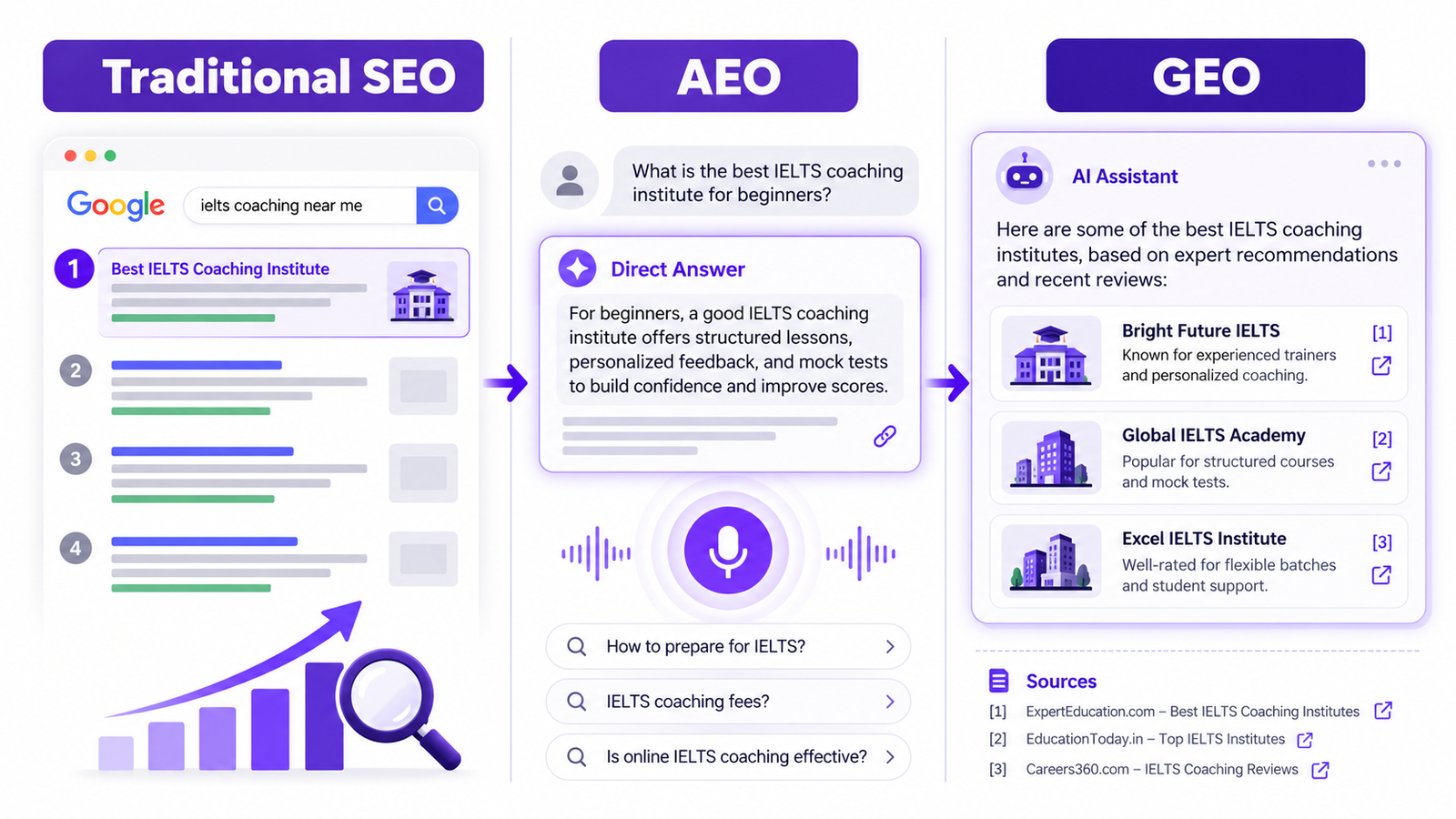
AI SEO is the practice of optimising your website, content and online presence so AI tools can find, understand and recommend your institute. For an IELTS centre, that means being the name that appears when a student asks ChatGPT, Gemini, Perplexity or Google AI Overviews for coaching advice.
Three terms often get mixed up:
- SEO (Search Engine Optimisation): gets your pages ranked in the list of search results.
- AEO (Answer Engine Optimisation): structures your content so it becomes the direct answer in featured snippets, “People Also Ask” boxes and voice search.
- GEO (Generative Engine Optimisation): makes your institute citable inside answers that AI systems write themselves.
All three share one foundation: a technically sound site with trustworthy, clearly written content. AI SEO simply adds the extra layers that AI systems need on top of it.
Why Does AI SEO Matter for IELTS Institutes?
IELTS students research differently from most buyers. They compare options, ask very specific questions, and often decide quickly because test dates and visa deadlines are fixed.
Here are the kinds of questions they now put to AI tools:
- “Which IELTS coaching is best for Band 7 in two months?”
- “IELTS Academic or General Training: which one do I need for Canada?”
- “Is online IELTS coaching as good as classroom coaching?”
- “IELTS coaching with daily speaking practice and mock tests near me”
AI tools answer these in a single block of text, often without the student clicking anything. When your institute is named in that block, you get a warm, pre-sold enquiry. When it isn’t, a competitor does.
There are three reasons to act now:
- Questions are getting longer and more specific. Students describe their exact situation, and AI answers match them to a specific institute.
- The shortlist is tiny. AI answers usually name two to four options, not ten blue links.
- Most competitors haven’t started. Few coaching institutes have set up crawler access, schema or answer-style content, so early movers have room to win.
This doesn’t replace paid channels. Meta Ads for coaching institutes and Google Ads still fill batches quickly. AI SEO builds a second, compounding source of enquiries that doesn’t stop when the ad budget does.
How Do AI Tools Decide Which Institute to Recommend?
No outsider knows the exact formulas, and they change often. But the patterns are consistent across ChatGPT, Gemini, Perplexity and Google AI Overviews:
- Access: Can the AI crawler actually reach and read your pages? Many institute sites block bots by accident or hide content behind heavy scripts.
- Clarity: A page that states the answer plainly is easier to quote than one that buries it in marketing copy.
- Consistency: Your institute name, address, phone number, fees and course details should match across your website, Google Business Profile and directories. Conflicting details make AI tools less sure about you.
- Authority: Reviews, student results, faculty credentials and mentions on other trusted sites all signal that you are a real, reputable institute.
- Freshness: Pages that reflect current test formats, batch dates and policies are safer for an AI tool to repeat.
For anything about the test itself, such as format, scoring or retake options, cite the official source rather than guessing. AI tools reward content that is accurate and verifiable, and so do students.
Benefits of GEO and AEO for IELTS Coaching
Done properly, GEO and AEO for IELTS institutes give you:
- Higher-intent enquiries. A student who reads “this institute offers weekly full-length mock tests with examiner-style Speaking feedback” in an AI answer arrives already convinced.
- A lower cost per lead over time. Content and technical fixes keep working after you publish them, unlike ad spend that stops when you pause.
- Brand authority. Being named as a recommended option builds trust before the student ever visits your site.
- Better traditional rankings. Clear structure, fast pages and schema help regular SEO too.
- Local visibility. Queries like “IELTS coaching near me” increasingly get AI-generated summaries that pull from Google Business Profiles and local sources.
- Fewer wasted clicks. Your answer-style pages qualify students before they call, so your counsellors speak to better-matched prospects.
Step-by-Step Guide to Getting Cited by AI
Follow these steps in order. You can do the first two in a single week.
Step 1: Audit Your Current AI Visibility
Before changing anything, find out where you stand. Write 20 prompts that real students would type (we give a template in the worked example below) and run them in ChatGPT, Gemini, Perplexity and Google.
For each prompt, record three things:
- Is your institute mentioned?
- How is it described, and is that description accurate?
- Which competitors appear instead, and what sources are cited?
This becomes your baseline. Without it, you can’t prove progress later.
Step 2: Open the Door for AI Crawlers
If AI bots can’t read your site, nothing else matters. Check these basics:
- robots.txt: Make sure you aren’t blocking crawlers such as GPTBot, ClaudeBot, PerplexityBot or Google-Extended unless you have chosen to. Whether to allow them is a business decision, but if you want citations, they need access.
- Rendering: Key content (fees, courses, batch timings) should appear in the page’s HTML, not only after heavy JavaScript loads.
- Speed and mobile: Most IELTS students browse on phones. Slow pages lose both students and crawlers.
- XML sitemap: Keep it clean and submitted in Google Search Console.
You may also add an llms.txt file that summarises your site for AI systems. Treat it as a low-cost extra, not a fix, because no major AI provider has confirmed it as a ranking signal.
Step 3: Rebuild Key Pages as Direct Answers
AI tools quote passages, not whole pages. So each important page should open its sections with a short, self-contained answer, followed by detail.
Take a page like “IELTS Coaching Fees.” Instead of leading with a long brand story, use a question heading and answer it immediately:
How much does IELTS coaching cost at [Institute Name]? Our [batch type] IELTS course costs [INSERT FEE], which includes [number] classes, [number] full-length mock tests and individual Speaking feedback. Fees differ for [online/offline/weekend] batches. [One sentence on how to book a demo class.]
Aim for roughly 50 to 150 words per answer block, written so it still makes sense if copied out of the page. Do this for your core pages: courses, fees, batch timings, results, faculty, online vs offline, and each branch location.
Step 4: Add Structured Data (Schema Markup)
Schema is code that tells machines exactly what your content means. For an IELTS institute, the most useful types are:
- EducationalOrganization or LocalBusiness for your institute details
- Course for each programme (IELTS Academic, IELTS General Training, crash courses)
- FAQPage for question-and-answer sections
- Person for named trainers and their qualifications
- Review or AggregateRating, only when based on real, visible reviews
Never mark up content that isn’t on the page or ratings you can’t back up. That can hurt trust with search engines.
Step 5: Build Trust Signals Beyond Your Website
AI tools cross-check you against other sources. Strengthen your footprint where students and AI systems look:
- Fully complete your Google Business Profile, with accurate categories, photos, services and regular posts.
- Collect detailed reviews that mention specifics, such as “Writing feedback improved my score from 6.0 to 7.0,” with the student’s permission.
- Get listed in relevant education directories and local business listings, keeping your name, address and phone number identical everywhere.
- Publish short YouTube videos of trainers explaining Writing Task 2 or Speaking Part 2 strategies, with clear titles and descriptions.
- Seek mentions from partners such as study-abroad consultants or universities, where genuine.
Step 6: Create Content That Answers the Questions Students Ask
Build a topic cluster around what students really search. Good starting points:
- IELTS Academic vs General Training, and which one fits which goal
- How to improve from Band 6 to Band 7 in each module (Listening, Reading, Writing, Speaking)
- Computer-delivered vs paper-based IELTS: what changes for students
- IELTS preparation timelines for 4, 8 and 12 weeks
- Online vs classroom IELTS coaching: how to choose
- Common Writing and Speaking mistakes, with examples
For each, answer first, elaborate second, and link to the relevant course page. Pair this with our AI SEO and GEO work for education brands if you want a team to run the whole cluster.
Step 7: Measure, Update and Repeat Monthly
Re-run your prompt list every month and compare against your baseline. Track mentions, accuracy of the description, and citations to your own pages. Also watch enquiry source data: ask every new student how they first heard of you, and add “ChatGPT or another AI tool” as an option on your enquiry form.
Update pages whenever fees, batches or test details change. Outdated information is a fast way to lose AI trust.
What Does It Cost and What Do You Need?
Budgets vary widely, so be wary of anyone quoting a flat price without looking at your site. The main cost factors are:
- The number of branches and service pages
- How much technical clean-up your website needs
- The volume of new content (course pages, FAQs, blogs, videos)
- Ongoing monitoring, reporting and updates
To get started you need:
- A website you can edit, or a developer who can
- A verified Google Business Profile
- Accurate details on fees, batches and trainers
- Real proof: reviews, results and trainer credentials you have permission to publish
- Someone on your team to review content for accuracy
One warning: no agency can guarantee that ChatGPT or any AI tool will name you. Anyone who promises that is selling you a story. What a good partner can do is remove the barriers, raise your credibility and give you a measurable plan.
Traditional SEO vs GEO vs AEO
Here is a quick comparison to help you see what each approach adds:
Traditional SEO | AEO | GEO | |
Goal | Rank pages in search results | Be the direct answer in snippets and voice | Be cited inside AI-written answers |
Where you appear | Google and Bing result lists | Featured snippets, People Also Ask, voice assistants | ChatGPT, Gemini, Perplexity, AI Overviews |
Content style | Keyword-focused pages | Question headings with short, direct answers | Clear, factual, quotable passages with proof |
Key technical needs | Speed, links, crawlability | Schema, clean headings | AI-crawler access, schema, consistent entity data |
How you measure it | Rankings, traffic | Snippet wins, impressions | Mentions, citations, AI-referred enquiries |
You don’t have to choose one. A strong SEO base supports the other two, which is why we build them together.
Worked Example: A 30-Day AI Visibility Test
Here is a simple test any IELTS institute owner can run this month, without any tools beyond the AI apps themselves.
Step 1: Use a prompt list like this one and replace the brackets with your details.
Prompt type | Example prompt | What to record |
Local | “Best IELTS coaching in [city]” | Are you listed? Who is above you? |
Goal-based | “IELTS coaching to reach Band 7 in 8 weeks” | Does the answer name institutes at all? |
Comparison | “Online vs offline IELTS coaching: which is better?” | Are any institutes cited as sources? |
Feature-based | “IELTS coaching with daily speaking practice and mock tests” | Do your features match what is quoted? |
Brand | “Is [Your Institute] good for IELTS?” | Is the description accurate and current? |
Step 2: Run each prompt in ChatGPT, Gemini, Perplexity and Google, and note the results in a spreadsheet.
Step 3: Fix what you find. If the brand prompt returns wrong fees, correct your pages and directory listings. If competitors dominate local prompts, strengthen your Google Business Profile and add location-specific pages.
Step 4: Re-test after 30 days and compare.
A quick checklist to run alongside it:
- AI crawlers are not blocked in robots.txt
- Fees, batch timings and course details are in the page HTML
- Each key page opens with a direct answer
- Schema is added and validated
- Name, address and phone match everywhere online
- At least 10 recent, detailed student reviews are live
Common Mistakes to Avoid
- Treating AI SEO as a one-time project. AI answers shift, so monitoring and updating are part of the job.
- Publishing generic AI-written blogs. Content with no real trainer insight, examples or data gives AI tools nothing worth citing.
- Blocking AI crawlers by accident. A security plugin or old robots.txt rule can quietly shut the door.
- Inconsistent institute details. Different phone numbers or fees across directories confuse both students and machines.
- Faking reviews or results. It breaks trust, can breach platform policies and rarely survives scrutiny.
- Ignoring the local angle. Most IELTS enquiries are location-driven, so branch pages and a strong Google Business Profile matter.
- Dropping paid ads too early. AI SEO is a compounding channel. Keep Google Ads for education running for steady enquiries while it builds.
FAQ
What is AI SEO for IELTS coaching institutes?
It is the process of optimising your institute’s website and online presence so AI tools like ChatGPT, Gemini, Perplexity and Google AI Overviews can find and recommend you. It combines technical SEO, answer-style content, schema and off-site trust signals. The aim is to appear in the answers students read before they ever click.
What is the difference between GEO and AEO?
AEO focuses on winning direct-answer spots such as featured snippets, People Also Ask boxes and voice results. GEO focuses on being cited in answers that generative AI tools write. They overlap heavily, so most strategies, including ours, treat them together.
Can an IELTS institute really get recommended by ChatGPT?
Yes, institutes can be mentioned when they have a crawlable site, clear information and credible proof across the web. But no one controls AI answers, and no agency can guarantee a mention. You can improve your odds by fixing the factors AI tools are known to rely on.
How long does AI SEO take to show results?
Technical fixes can take effect within weeks, but visible changes in AI mentions usually take a few months of consistent work. Local and branded prompts tend to move first. Expect to track progress monthly rather than daily.
Does llms.txt help my institute get cited?
It costs little to add, but no major AI provider has confirmed that it affects rankings or citations. Treat it as an optional extra. Crawler access, clear content and trust signals matter far more.
Do I still need Google Ads and Meta Ads?
Yes. Paid channels bring predictable enquiries now, while AI SEO builds long-term visibility. Together they form a stronger pipeline, which is the idea behind our Student Flow System.
How can I check whether my institute is being cited by AI tools?
Run a set of real student prompts in ChatGPT, Gemini, Perplexity and Google, and record whether you appear and how you’re described. Repeat monthly. Also add an “AI tool” option to your enquiry form’s “How did you hear about us?” field.
Is AI SEO worth it for a small, single-branch institute?
Often more than for large chains. A single-branch institute can win local and niche prompts, such as “IELTS coaching for working professionals in [area],” without needing a national brand. Start with your Google Business Profile, fee and batch pages and a handful of strong answer-style pages.
Conclusion
Students are already asking AI tools who to trust with their IELTS preparation. The institutes that get named are not necessarily the biggest. They are the ones that are easy for machines to read, clear in what they offer and backed by real proof.
Three things matter most. First, open the door by allowing crawlers and fixing your technical basics. Second, write pages that answer student questions in plain, quotable language. Third, build a consistent, credible footprint across Google, directories and reviews, then measure it every month.
If you would like a clear picture of where your institute stands today, we can map it for you. Book a free consultation call and we’ll show you how AI search visibility fits into your own Student Flow System, alongside your ads, social media and follow-up automation.