Your classrooms are great. Your teachers are great. So why does every admission season still feel like guesswork?
If you run a school, coaching institute or college in India, you have probably tried hoardings, newspaper ads and a few boosted social posts, and still got unpredictable enquiries. Digital marketing for educational institutes fixes this by turning admissions into a measurable system. You know where each enquiry comes from, what it costs and how many turn into enrolments.
This guide explains how it works in India, the channels that matter, a step-by-step launch plan, realistic budgets, common mistakes and answers to the questions owners ask most.
Key Takeaways
- Digital marketing for educational institutes works best as a connected system (attract, capture, nurture, enrol), not as random posts and ads.
- Parents and students research online before they ever call you, so your Google listing, website and reviews decide whether you make the shortlist.
- Meta Ads create demand and Google Ads capture it. Most institutes need both, plus local SEO.
- Speed of follow-up matters more than ad creative. A lead contacted within minutes converts far better than one called back next day.
- Track cost per enquiry, cost per admission and enquiry-to-admission rate every week. These three numbers tell you what to fix.
What Is Digital Marketing for Educational Institutes?
Digital marketing for educational institutes means using online channels to reach prospective students and parents, answer their questions and guide them to enquire, visit or enrol. The channels include search engines, social media, video, email, WhatsApp and paid ads.
It applies to any institute that depends on admissions: CBSE and state-board schools, play schools, coaching centres, colleges, skill-training institutes and independent educators.
The difference between this and simply “being on Instagram” is the system behind it. Every post, ad and web page is connected to a measurable goal such as an enquiry, a demo class, a campus visit or an admission.
You will also hear related terms like student lead generation, admission marketing and school marketing. They all describe the same idea: a predictable way to fill seats.
Why Is Digital Marketing Important for Indian Institutes?
India is a mobile-first country, and education decisions now start on a phone screen. A parent comparing schools or a student choosing a coaching centre will search, read reviews, watch videos and check your social pages before calling anyone.
Here is why it matters for you specifically:
- Your audience is already online. Students and parents spend that time on YouTube, Instagram, WhatsApp and Google.
- Trust is built before the first call. Google reviews, student stories and a clear website make a stranger comfortable enough to enquire.
- Admissions are seasonal. Digital campaigns can be scaled up before board results, entrance exams or the new academic session, and paused when seats are full.
- You can target by location. A school can show ads only to parents within 6 to 8 km. A coaching institute can target Class 10 and 12 students and their parents in specific cities.
- Your competitors are already doing it. If the institute down the road appears on Google and you do not, they get the enquiry.
For smaller institutes and independent educators, digital also levels the field. You do not need a huge budget to be found, only a clear plan.
How Does Digital Marketing for Educational Institutes Work?
Think of it as a four-stage flow. At DigigoFly we call our version of this The Student Flow System, and you can read more about how The Student Flow System brings in student enquiries.
Stage 1: Attract. Ads, SEO, videos and social posts put your institute in front of the right people at the right time.
Stage 2: Capture. A landing page, lead form or WhatsApp click collects the parent’s or student’s contact details. One page, one clear action.
Stage 3: Nurture. Automated WhatsApp, SMS or email replies go out instantly. A counsellor then follows up with a call. Brochures, fee details, demo class links and testimonials move the lead forward.
Stage 4: Enrol. The counsellor books a visit or demo, answers objections and closes the admission. You record the result so you know which channel produced it.
Stage | What happens | Typical tools |
Attract | Right audience sees your institute | Meta Ads, Google Ads, SEO, YouTube |
Capture | Enquiry details are collected | Landing page, lead form, WhatsApp button |
Nurture | Instant reply and counsellor follow-up | WhatsApp automation, CRM, email |
Enrol | Visit, demo, admission | Counselling calls, campus tours, payment link |
Most institutes only do Stage 1 and wonder why admissions do not improve. The money is usually lost in Stages 2 and 3.
Best Digital Marketing Channels for Educational Institutes
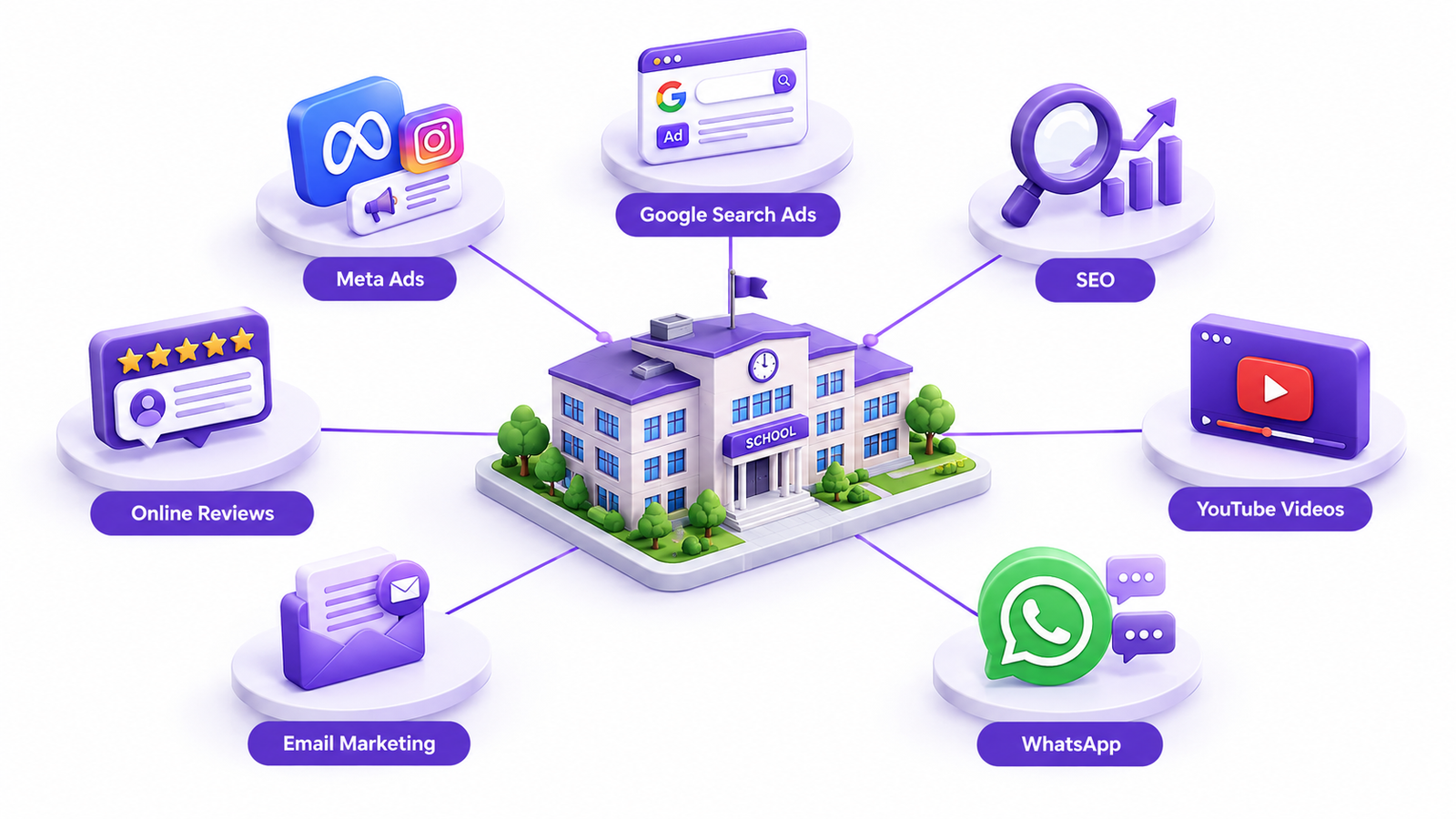
You do not need every channel on day one. Start with the ones that match how your students and parents actually decide.
Meta Ads (Facebook and Instagram)
Meta Ads are strong for reaching parents and students who are not searching yet but would be interested if they saw you. They work well for admission drives, free demo classes, scholarship tests and open-house events.
If you run a coaching business, see how Meta Ads for coaching institutes [CONFIRM URL] can fill batches with qualified enquiries.
Google Ads (Search)
When someone searches “best CBSE school near me” or “NEET coaching in Nagpur”, they are ready to act. Search ads place you at the top at that moment. This is high-intent traffic, so cost per click is higher but conversion is often better.
Schools can explore Google Ads for schools to capture parents at the shortlisting stage.
SEO and GEO (Search and AI Answers)
SEO for educational institutes brings free, long-term traffic from Google. Start with your Google Business Profile, location pages, course pages and helpful blog content such as fee guides, admission process explainers and exam tips.
GEO (generative engine optimisation) is the newer layer. Parents now ask AI tools questions like “which are the best schools in my city?” Clear, factual, well-structured pages with consistent business details give you a better chance of being mentioned. Our guide to AI SEO and GEO for education brands [CONFIRM URL] explains how.
Social Media and Video
Short videos work well for education. Campus walkthroughs, teacher introductions, student achievements, a day in the life, and answers to common parent questions all build trust. Post consistently on Instagram and YouTube, and reuse the same videos in your ads.
WhatsApp, Email and Marketing Automation
In India, WhatsApp is where most parents prefer to talk. Automated replies, reminders for demo classes, fee-deadline nudges and result announcements save your team hours and stop leads from going cold.
Reviews and Reputation
Ask happy parents and students to leave Google reviews. Reply to every review, including the critical ones, politely. A rating of 4.3 with 150 genuine reviews will often beat a rating of 4.8 with 6 reviews.
Benefits of Digital Marketing for Educational Institutes
When it is set up properly, you can expect:
- Predictable enquiries. Instead of waiting for word of mouth, you can plan how many leads you need per month.
- Measurable results. You can see cost per enquiry, cost per admission and which campaign brought which student.
- Better targeting. Reach Class 9 parents, graduating students or working professionals, depending on your course.
- Lower waste. You stop paying for audiences who will never enrol, such as people outside your catchment area.
- Stronger brand recall. Repeated, consistent visibility makes your institute the one people remember.
- Faster feedback. You can test two fee messages or two ad videos in a week, not wait a whole admission season.
- Higher lifetime value. Alumni, parent communities and referral campaigns keep bringing students for years.
Step-by-Step Guide to Get Started
Here is a practical sequence you can follow, whether you run one campus or several.
Step 1: Set a Clear Admission Goal and Work Backwards
Start with seats, not likes. Decide how many admissions you want, then calculate the enquiries needed.
For example, if you want 50 new admissions and about 1 in 10 enquiries converts, you need around 500 enquiries. Divide your budget by 500 to see the maximum cost per enquiry you can afford.
Write down three numbers: target admissions, current enquiry-to-admission rate, and the average fee per student.
Step 2: Fix Your Digital Foundation
Before spending on ads, make sure the places you send people to are ready.
- A mobile-friendly website that loads in under 3 seconds
- Clear pages for courses, fees (or fee ranges), facilities, results and contact details
- A claimed and complete Google Business Profile with photos, timings and phone number
- One dedicated landing page per campaign, with a single call-to-action
- A WhatsApp click-to-chat button
Many institutes skip this step and pay for traffic that bounces.
Step 3: Build Trust Assets
Parents are making a big decision. Give them proof.
- Short testimonial videos from parents and students (with written permission)
- Faculty introductions with qualifications and experience
- A campus or classroom tour video
- Verified results, shown honestly and with the correct year
A quick note on claims: avoid guarantees like “100% selection” or unverifiable rank claims. India’s consumer regulators have tightened rules on misleading coaching and education advertisements. [ADD CREDIBLE SOURCE: link to the CCPA guidelines on misleading advertisements in the coaching sector and the ASCI code for education advertising.]
Step 4: Launch Your Paid Campaigns
Start small and learn fast.
- Run Meta Ads for lead generation and awareness, using a video or carousel and an instant form or landing page.
- Run Google Search Ads on high-intent keywords such as “[course] coaching in [city]” or “admission open [class] [city]”.
- Use location targeting tightly and add negative keywords like “free”, “jobs” and “PDF” to avoid irrelevant clicks.
- Test at least 2 or 3 creatives and 2 audiences before scaling anything.
Step 5: Follow Up Within Minutes
This is where most admissions are won or lost. Set up an automatic WhatsApp message the moment someone enquires, with the brochure and a link to book a call or demo. Then have a counsellor call within 5 to 10 minutes during working hours.
Use a simple CRM or spreadsheet to track every lead’s status: new, contacted, demo booked, visited, enrolled, lost.
Step 6: Track, Review and Improve Weekly
Review these numbers every week:
- Cost per enquiry (CPL)
- Enquiry-to-demo or enquiry-to-visit rate
- Cost per admission
- Lead source with the highest enrolment rate
Pause what is not working, put more budget behind what is, and ask your counselling team why leads were lost. Their feedback often reveals fixable issues like pricing questions or slow response.
How Much Does It Cost? A Worked Example
Budgets vary by city, course value and competition. DIGIGOFLY BENCHMARK: typical monthly ad spend ranges for schools, coaching institutes and colleges.
To show how the maths works, here is a purely illustrative example with assumed numbers. Replace them with your own.
A coaching institute spends ₹1,000 per day on Meta Ads for one month:
Metric | Assumed value |
Monthly ad spend | ₹30,000 |
Cost per enquiry | ₹150 |
Enquiries received | 200 |
Demo class attendance (25%) | 50 students |
Enrolments (20% of demo attendees) | 10 students |
Cost per admission | ₹3,000 |
Annual fee per student | ₹40,000 |
In this scenario, ₹30,000 in ads leads to ₹4,00,000 in annual fees. The point is not these exact numbers. The point is that once you know your own conversion rates, you can calculate your return before you scale.
Besides ad spend, remember to budget for:
- Landing pages and website improvements
- Video and creative production
- CRM and WhatsApp automation tools
- Your counselling team’s time or an agency fee
Common Mistakes to Avoid
- Chasing followers instead of admissions. Likes do not fill seats. Tie every activity to an enquiry or enrolment.
- Sending ad traffic to the homepage. A focused landing page with one action converts much better.
- Slow follow-up. A lead that waits 24 hours has already spoken to three other institutes.
- Hiding fees completely. Parents compare. Giving a range or a clear process builds trust and filters out poor-fit enquiries.
- Ignoring Google reviews. Unanswered or missing reviews hurt trust and local search ranking.
- Not tracking sources. If you do not know which campaign brought the admission, you cannot repeat it.
- Overpromising in ads. Guaranteed results and inflated claims can damage reputation and lead to ad rejections or regulatory trouble.
- Collecting data carelessly. Students’ and parents’ details are personal data. Collect only what you need, state how you will use it, and handle consent properly under India’s data protection rules.
- Stopping after one season. Digital marketing compounds. SEO, reviews and remarketing audiences get stronger over time.
Digital Marketing vs Traditional Marketing for Institutes
Traditional marketing still has a place, especially for local trust. Banners near the campus, pamphlets and community events can support your digital work. But they work best when connected to it.
Factor | Digital marketing | Traditional marketing |
Targeting | By location, age, interest, search intent | Broad, by area or readership |
Measurement | Enquiries, cost per lead, admissions by source | Hard to measure |
Speed | Campaigns live in days | Printing and booking take longer |
Flexibility | Change or pause anytime | Locked in once printed |
Cost control | Start small, scale what works | Usually fixed upfront |
Two-way contact | Instant chat and replies | One-way message |
The smartest approach is to use banners, events and referrals to build local awareness, and use digital to capture and convert the interest they create.
Quick Launch Checklist
- Admission goal and target cost per admission defined
- Google Business Profile claimed, complete and active
- Mobile-friendly website with clear course and contact pages
- Landing page and WhatsApp button live
- Testimonial and campus videos ready
- Meta and Google conversion tracking installed
- Automated WhatsApp reply set up
- Counsellor assigned to call within 10 minutes
- Weekly review meeting scheduled
FAQs
What is digital marketing for educational institutes?
It is the use of online channels such as Google, social media, video, WhatsApp and email to attract prospective students and parents and convert them into enquiries and admissions. It focuses on measurable results, not just visibility.
Which digital marketing channel is best for schools in India?
A mix works best. Google Search Ads and local SEO catch parents who are actively looking for schools, while Meta Ads and video build awareness before admission season. Reviews and WhatsApp follow-up help convert both.
How much should a coaching institute spend on digital marketing?
There is no single figure. Start with a budget you can sustain for at least 2 to 3 months, then calculate based on your target admissions and cost per admission. Many institutes begin with a modest daily ad budget and scale once results are proven.
How long does it take to see results?
Paid ads can bring enquiries within days. SEO and reputation usually take 3 to 6 months to show strong results. Expect your first month to be about testing and learning.
Is SEO or paid advertising better for educational institutes?
Both do different jobs. Paid ads give fast, controllable enquiries. SEO builds free, long-term visibility. Most institutes should start with paid ads for quick results while building SEO in parallel.
Can small institutes and independent educators use digital marketing?
Yes. Small institutes often benefit most because digital allows precise local targeting. A tight budget, one strong offer such as a free demo class, and quick follow-up can deliver good results.
Do we need an agency or can we do it in-house?
You can start in-house with basic social posts and a Google profile. An education-focused agency helps when you need ad strategy, tracking, automation and constant optimisation. Choose one that talks about admissions and cost per admission, not just reach and impressions.
How do we measure whether digital marketing is working?
Track cost per enquiry, enquiry-to-admission rate, cost per admission and lead source. If you cannot trace an admission back to its source, set up proper tracking and a lead status sheet first.
Conclusion
The institutes that win admissions consistently are not always the biggest or the oldest. They are the ones that are easy to find, easy to trust and quick to reply.
Three things to remember. First, build the foundation before spending on ads: a good Google profile, a focused landing page and real proof. Second, treat enquiries as the start of a conversation and follow up in minutes. Third, measure cost per admission every week and let the numbers guide your next move.
If you want a ready-made system instead of building it piece by piece, we can help. Book a free consultation call and we will map out a Student Flow System for your institute, covering ads, SEO, automation and follow-up.