A parent calls your front desk and says, “My daughter has already shortlisted you. She just wants to see the campus.” You never ran an ad for her. But she watched a student vlog, read a Reddit thread and asked an AI tool to compare you with two other colleges, all before you knew her name.
This is how Gen Z students search for colleges today, and it explains why many institutes see fewer enquiries even when their Google rankings haven’t moved. In this guide, you’ll see each stage of the journey, what students want at every step, and a practical plan to show up where they actually look.
Key Takeaways
- How Gen Z students search for colleges has changed: Google is now one of the last checkpoints, not the first.
- Discovery happens before search. Reels, Shorts and YouTube vlogs put your institute in front of students who weren’t even looking yet.
- Student voices beat brand voices. Prospects trust current students, alumni and Reddit threads more than brochures.
- AI tools now shortlist colleges. Accurate, structured and consistent information about fees, courses and outcomes decides whether you get mentioned.
- You don’t need to be everywhere. You need one useful asset for each stage of the journey, tracked in one system.
What Does the Gen Z College Search Journey Look Like?
Gen Z students (roughly those born between 1997 and 2012) don’t follow a straight line from “I need a college” to “I’ll apply.” They loop. They discover, check, doubt, ask friends, check again and only then visit a website.
A typical path looks like this:
Short video → student content → community forums → AI search → Google → college website → campus visit or call → application
Notice what’s missing: a single moment where the student “starts searching.” By the time someone types your college name into Google, they have often spent days or weeks forming an opinion about you.
That opinion is built from sources you don’t fully control. Your job is not to control it but to be present, accurate and useful inside it.
Why This Matters for Colleges and Institutes
If your marketing still assumes “student searches keyword, student clicks ad, student fills form,” you are measuring only the last part of the journey.
Here is what that blind spot costs you:
- You lose students before they reach you. If a competitor appears in a student’s Reels feed and you don’t, they enter the shortlist first.
- Your cost per lead rises. Without upstream awareness, every enquiry has to be bought at the bottom of the funnel, where competition for clicks is highest.
- Low-quality leads increase. Students who haven’t seen real campus content often enquire with unrealistic expectations and drop off after the first call.
- Parents stay in the dark. Parents are co-decision makers, especially for fees and safety, and they run their own searches (often on Google and WhatsApp groups).
The good news: understanding the Gen Z college search journey gives smaller institutes a real chance. You don’t need a famous brand to be useful, and usefulness is what students reward.
How Gen Z Students Search for Colleges, Stage by Stage
Stage 1: Discovery on Short Video (Instagram Reels, YouTube Shorts)
Discovery now happens by interruption, not intention. A student scrolling Reels sees “A day in the life of a BBA student” and a college enters their mind.
What students want at this stage:
- A feel for campus life, not a fee structure
- Faces that look like them
- Quick, honest, unpolished moments
What works: day-in-the-life clips, hostel and canteen tours, “things I wish I knew before joining,” and short faculty explainers.
Stage 2: Deeper Exploration on YouTube and Student Vlogs
Once interest is sparked, students look for longer, more detailed content. YouTube is where they ask: What will my week actually look like?
What works: semester walkthroughs, placement-season vlogs, lab and library tours, and honest “first year review” videos by current students.
Stage 3: Peer Validation on Reddit and Online Communities
Students know brochures are written to sell. So they go where strangers speak candidly: Reddit, Quora, Discord servers and Telegram or WhatsApp groups.
Typical questions they type include:
- “Is [college] worth the fees?”
- “How are placements at [college] for [course]?”
- “[College A] or [College B] for BBA?”
- “Any current students here who can share their experience?”
You can’t (and shouldn’t) fake these conversations. But you can read them. Every recurring doubt is a content brief written for you by your own prospects.
Stage 4: Comparison Through AI Search Tools
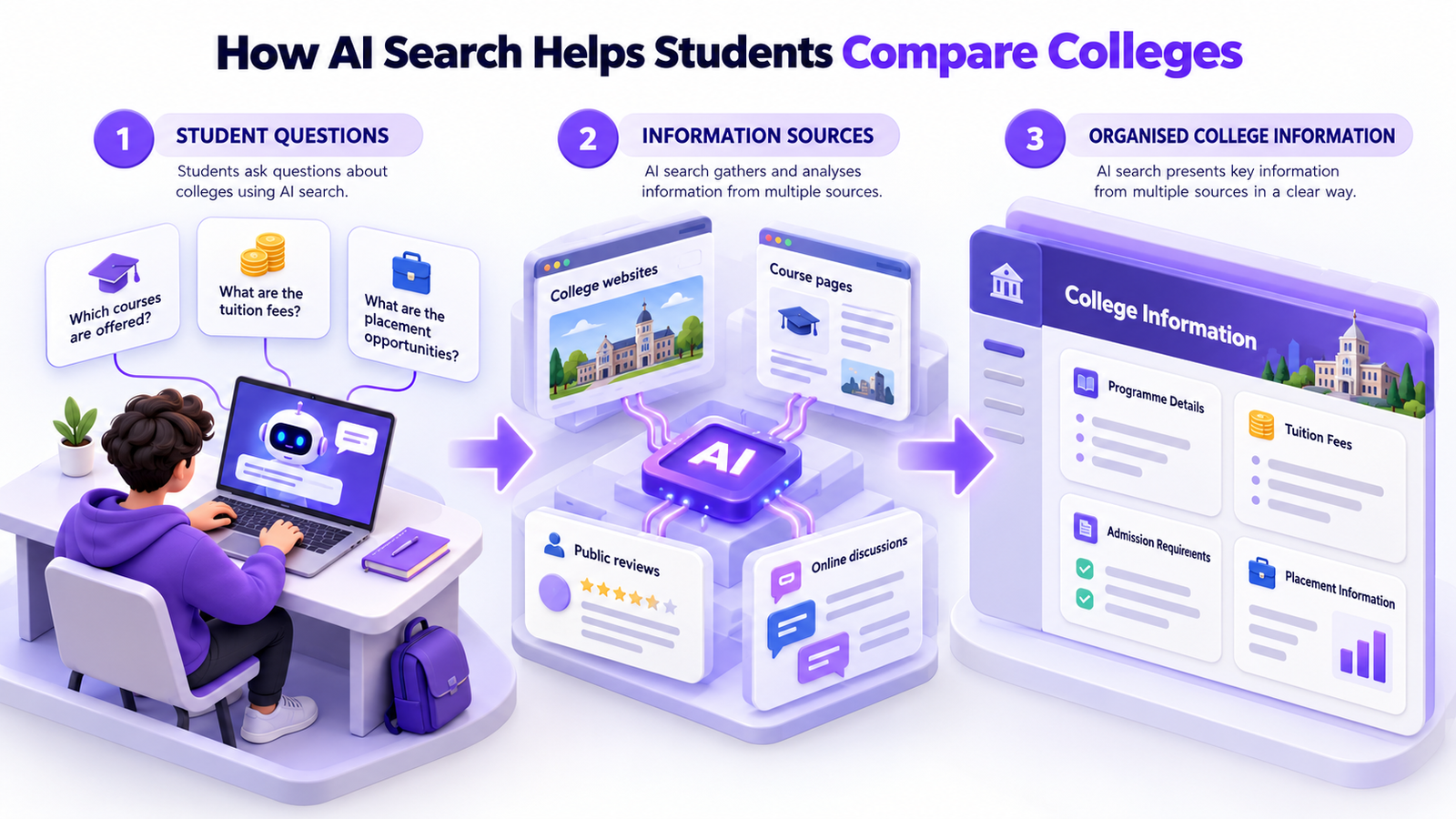
This is the newest layer. Instead of opening ten tabs, students ask an AI assistant: “Compare the top private BBA colleges in Kolkata by fees, placements and campus life.”
AI tools pull from your website, your listings, news coverage, reviews and public discussions. If that information is outdated, inconsistent or missing, the AI will fill the gap with whatever it finds, or skip you entirely.
This is why AI SEO and GEO (generative engine optimization) have become a core part of education marketing. We cover this in more depth in our guide to AI SEO and GEO for education brands.
Stage 5: Validation on Google
Google hasn’t disappeared. It has changed roles. Students use it to verify: Is this college real? What are the official fees? Is it approved? What do Google reviews say?
What matters here:
- A complete, well-reviewed Google Business Profile
- Clear course pages that answer fee, eligibility and placement questions
- Branded search results that show consistent, current information
Stage 6: Final Check on Your Website
By the time a student lands on your site, they are not browsing. They are looking for a reason to say yes or a reason to say no.
They scan for:
- Fees and scholarships, stated plainly
- Admission dates and process
- Placement data with real names and numbers
- A fast, mobile-friendly experience
- An easy way to talk to a human (WhatsApp, call, counselling slot)
Stage 7: Campus Experience and the Parent Layer
The campus visit, virtual tour or counselling call is the final proof point. And this is where parents step in strongly: fee transparency, hostel safety and career outcomes matter to them as much as campus vibe matters to the student.
Many guides skip this, but a Gen Z student’s decision is rarely made alone. Build content for both audiences.
What Each Platform Does in the Search Journey
Platform | What the student is looking for | What your institute should offer |
Instagram Reels / Shorts | Discovery, lifestyle, peer perspective | Short, real student moments |
YouTube | Deeper exploration | Vlogs, tours, course explainers |
Reddit / communities | Honest opinions | Monitoring, helpful replies, FAQs |
AI search tools | Quick comparisons | Structured, consistent, current data |
Verification | Reviews, course pages, official info | |
Website | Final proof | Clear fees, outcomes, easy contact |
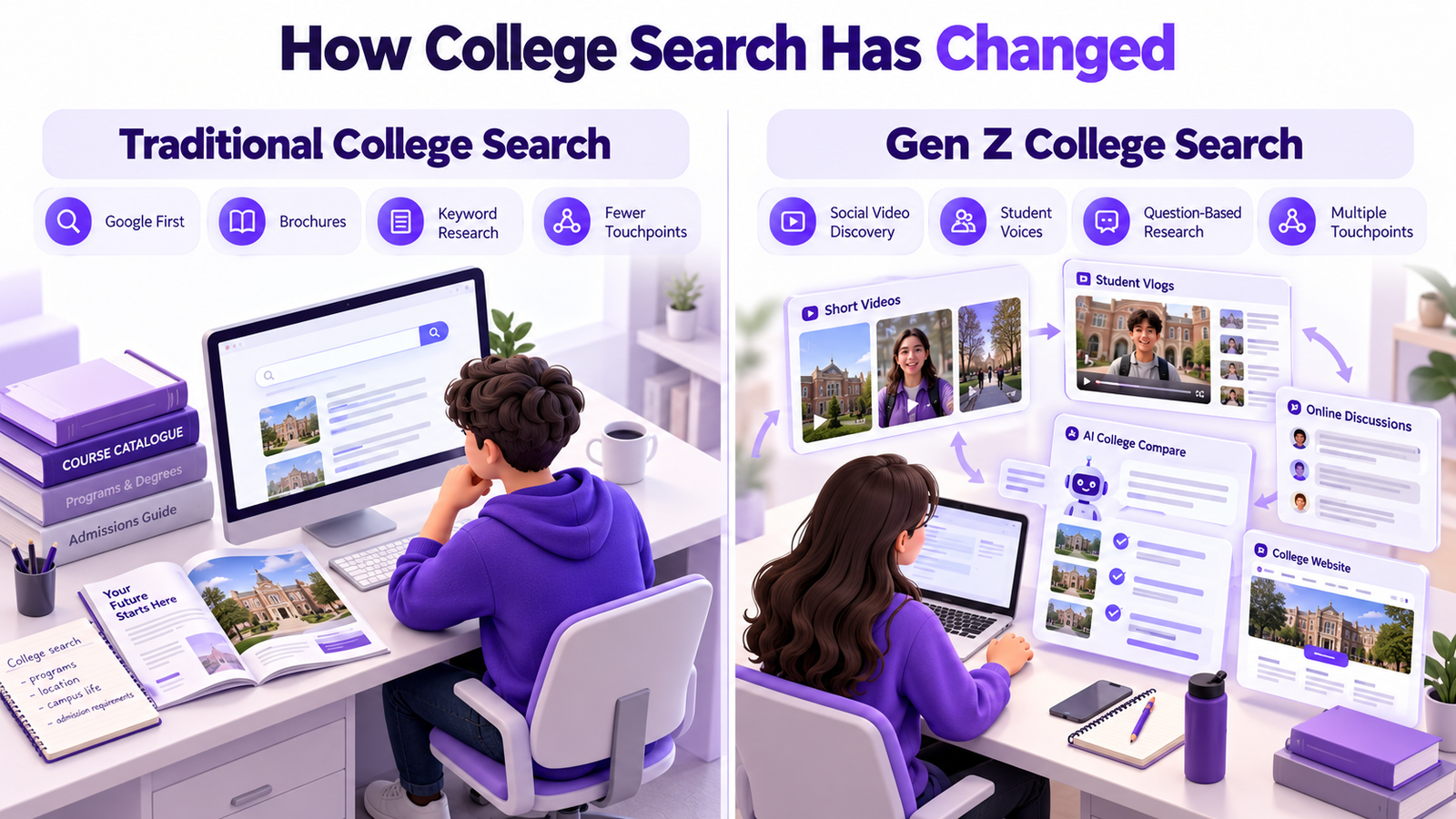
Old Search Journey vs Gen Z Search Journey
Traditional journey | Gen Z journey | |
Starting point | Google search | Reel, vlog or friend’s message |
Trusted voice | Brochure, ranking lists | Current students, alumni, communities |
Research style | Keyword-based | Question-based, conversational |
Number of touchpoints | 2–3 | 6–10 or more |
Role of Google | Discovery | Validation |
Role of website | Information source | Final verification |
The takeaway: you are not replacing your old strategy. You are adding the layers that come before it.
Benefits of Meeting Gen Z Where They Search
When your institute is useful at every stage, you get measurable advantages:
- Earlier shortlisting. You enter the consideration set before competitors do.
- Better-quality enquiries. Students arrive informed, so counsellors spend time closing, not explaining basics.
- Lower dependence on paid clicks. Content and reviews keep working long after a campaign ends.
- Stronger trust. Real student stories answer objections you would otherwise need a long call to handle.
- More resilient marketing. If one channel’s reach drops, the others still carry you.
Step-by-Step Guide: Build a Gen Z-Ready Search Presence
Step 1 — Map the journey with your own data
Ask your last 50 admitted students one question: “Where did you first hear about us, and what did you check before applying?” Record answers in a simple sheet. You’ll quickly see which stages matter most for your audience.
Also review your admissions team’s call logs. The most repeated questions become your content calendar.
Step 2 — Turn student questions into content
Take your top 10 questions (fees, hostel life, placements, internships, difficulty of classes) and answer each in four formats:
- A 30-second Reel
- A longer YouTube video
- A blog or FAQ page
- A WhatsApp-friendly short answer for counsellors
One question, four assets, multiple stages covered.
Step 3 — Build a student creator programme
User-generated content works because it feels real. Choose 5–10 current students and give them a simple brief and a small stipend or recognition.
Let them make:
- Day-in-the-life videos
- Hostel and campus tours
- Event and fest coverage
- Live Q&A sessions
- Club and society spotlights
Set light guardrails (accuracy, no false claims, consent for faces) but resist the urge to polish everything. Over-produced content often performs worse for this audience.
Step 4 — Support discovery with targeted Meta Ads
Organic reach is unpredictable. Promote your best student-made videos using Meta Ads to reach students by city, interest and age, then retarget people who watched them with enquiry or counselling-call offers. Our guide on Meta Ads for colleges and coaching institutes walks through campaign setup.
Step 5 — Make your information AI-ready
To be recommended by AI tools, your information must be accurate, structured, current and consistent everywhere. Check that these are clear on your website and listings:
- Programmes offered and who they’re for
- Fees, scholarships and payment options
- Eligibility and admission process
- Placement outcomes and recruiter names
- Location, approvals and accreditations
Use FAQ sections and schema markup so machines can read your pages easily.
Step 6 — Strengthen your Google presence
Collect reviews from current students and alumni, update your Google Business Profile with fresh photos, and ensure each course has its own page. If you run search campaigns, our Google Ads for schools and colleges page explains how to capture students at the validation stage.
Step 7 — Connect everything with fast follow-up
A student who watches your Reel, then enquires at 11 pm, shouldn’t wait until tomorrow afternoon. Set up automated WhatsApp and email replies, assign leads to counsellors instantly and nurture those not ready to apply. This is the core idea behind our Student Flow System: one connected path from first view to confirmed admission.
A Worked Example
This is an illustrative scenario, not a real client result.
Imagine a private management college in a tier-2 city that spends most of its budget on Google search ads for “MBA admission.” Enquiries are flat and costs keep rising.
Here’s how it could re-balance:
- Content: Five current MBA students record weekly 30-second Reels about internships, classes and hostel life.
- Paid reach: The college puts ₹1,000/day behind the top-performing Reel on Meta Ads, targeting 17–24 year olds in nearby districts.
- Retargeting: Viewers who watch over 50% are shown a “Free counselling call” lead ad.
- Search and AI readiness: The website’s MBA page is updated with fees, placement list and FAQs, and Google reviews are refreshed.
- Follow-up: Every lead gets an instant WhatsApp reply and a call within 15 minutes.
What the team would track after 60–90 days: cost per enquiry, enquiry-to-counselling rate, counselling-to-application rate and branded search growth.
FAQs
How do Gen Z students search for colleges online?
They usually start on short-video platforms like Instagram Reels and YouTube, then check student reviews and Reddit, compare options with AI tools, verify on Google and finally visit the college website. The journey has many touchpoints before an enquiry is made.
Do Gen Z students still use Google to find colleges?
Yes, but mostly to verify rather than discover. They use Google to confirm fees, approvals, reviews and official details after they have already heard about a college elsewhere.
Which social media platform is best for college admissions marketing?
It depends on your audience, but Instagram Reels and YouTube are the strongest for discovery and exploration. Add WhatsApp for follow-up, since it’s where most Indian students and parents prefer to talk.
Why do students trust Reddit and student reviews more than college websites?
Because they come from people with no incentive to sell. Students want honest answers about teaching quality, hostels and placements, which only people who have lived it can give.
How can a college appear in AI search results?
Publish accurate, structured and consistent information about programmes, fees, outcomes and admissions across your website and listings. Use FAQs, schema markup and regular updates so AI tools can read and trust your content.
Is SEO still important for colleges?
Yes. SEO remains the foundation for validation and for AI discovery, but it now works alongside video, community presence and AEO/GEO techniques rather than replacing them.
How long does it take to see results from a Gen Z-focused strategy?
Paid reach can show results in a few weeks. Content, reviews and AI visibility usually build over 3–6 months. Faster follow-up and clearer pages can improve conversions almost immediately.
How much should a college spend on digital marketing?
There’s no fixed number. Start with a budget you can sustain for at least 90 days, split across content, paid reach and follow-up, then shift spend toward the stages that produce the best-quality enquiries.
Conclusion
The biggest shift in how Gen Z students search for colleges is not a new platform. It’s that the decision now forms before the search box. By the time a student reaches Google or your website, the shortlist is often half-built.
Three things matter most. Be present where discovery happens, with real student stories. Keep your facts clear and consistent so people and AI tools can trust them. And respond fast, so interest turns into conversation.
If you’d like to build this as one connected system instead of scattered campaigns, book a free consultation call with DigigoFly and we’ll map your own Student Flow System, from first Reel view to confirmed admission.