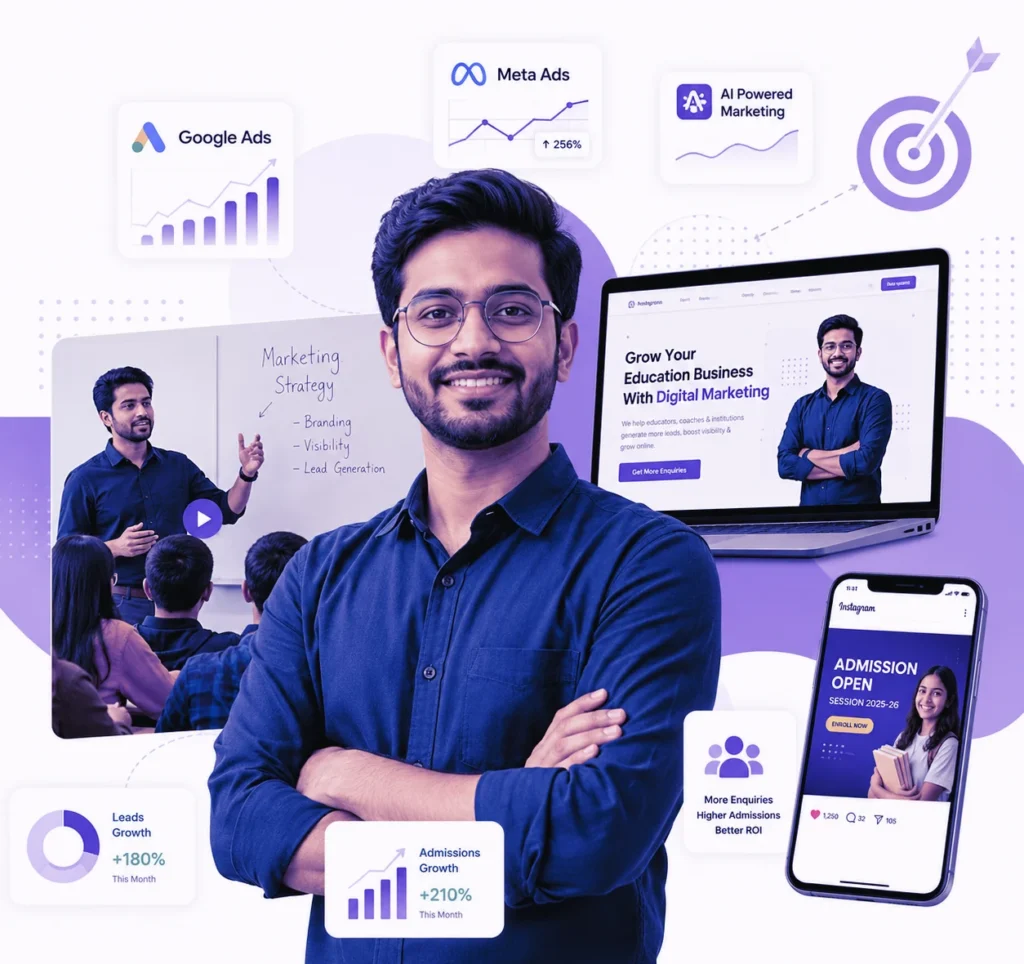
Education team reviewing admissions funnel results with the best digital marketing EdTech agency
You are running ads, posting on Instagram and sending WhatsApp broadcasts. Yet enquiries stay low, and the few that arrive rarely turn into admissions. Sound familiar?
For most school owners and coaching founders, the problem is not effort. Education marketing simply works differently from selling products. Parents take weeks to decide, students research on their own, and trust matters more than discounts. Choosing the best digital marketing EdTech agency can close that gap, but only if you know what to look for.
This guide gives you 10 clear reasons to pick a specialist partner, a checklist to evaluate one, how pricing usually works, and the mistakes that waste budget.
Key Takeaways
- The best digital marketing EdTech agency understands the full admissions journey, from first click to enrolled student, not just clicks and likes.
- Education audiences are split: parents, students and decision makers each need different messages and channels.
- Specialists shorten the learning curve on Meta Ads, Google Ads and AI search visibility because they have already seen what works in education.
- Lead follow-up (calls, WhatsApp, email) decides admissions as much as the ad itself, so automation matters.
- Judge an agency on cost per admission and transparent reporting, not on follower counts or impressions.
What Is a Digital Marketing EdTech Agency?
A digital marketing EdTech agency is a marketing partner that focuses on education brands: schools, colleges, coaching institutes, online course creators, independent educators and ed-tech startups. Instead of serving every industry, it builds its systems around one goal, which is turning interest into enquiries and enquiries into enrolments.
In practice, such an agency manages several channels together:
- Paid ads on Meta (Facebook and Instagram) and Google to generate student leads.
- SEO and AI search visibility so your institute appears in Google results and in answers from AI tools.
- Social media and creative content that builds trust with parents and students.
- Marketing automation that follows up with every lead on WhatsApp, email and calls.
- Tracking and reporting that connects spend to actual admissions.
The word “best” here does not mean the biggest or the loudest. It means the agency whose process, education experience and reporting fit your institute.
Why Is Specialist Marketing Important for Education Businesses?
Education is a high-trust, high-consideration purchase. A parent choosing a school or a student choosing a coaching centre may compare five options over several weeks. They read reviews, ask friends, watch videos and visit websites before they ever fill a form.
That creates three challenges for school and institute owners:
- Seasonality. Admissions run in short windows, so a slow campaign launch can cost you an entire intake.
- Multiple decision makers. A student may find you, but a parent approves the fee.
- Long follow-up cycles. A lead who does not answer the first call may still enrol after the third touchpoint.
A general agency can run ads. A specialist knows these patterns and builds around them. Industry sources also show that education leads are expensive to acquire and slow to convert when follow-up is weak. That is exactly where specialist experience pays for itself.
10 Reasons to Choose the Best Digital Marketing EdTech Agency
Here are the ten reasons that matter most when you are deciding who should handle your admissions marketing.
1. They Understand Your Audience Deeply
A good EdTech agency does not guess who your students are. It researches them. For a school, the buyer is usually the parent, and the message is about safety, results and values. For a coaching institute, the buyer may be a student aged 16 to 22 who cares about rank improvement and mentors.
Expect your agency to build separate audience profiles, use surveys or counsellor insights, and write ads in the language your audience actually uses. This alone can improve lead quality more than any budget increase.
2. They Have Real Education Industry Experience
Education has its own vocabulary, calendar and compliance expectations. Admission cycles, board exam seasons, scholarship tests and counselling sessions all shape when and how you should advertise.
An agency with education experience will already know when enquiries peak, which offers attract serious families, and which claims you should avoid. Ask to see case studies and references from institutes similar to yours.
3. They Master Paid Media for Lead Generation
Paid campaigns are usually the fastest way to generate student enquiries. But they are also the quickest way to waste money. A specialist knows how to structure campaigns by course, city and intent, and how to use lead forms, click-to-WhatsApp ads and retargeting.
This is why choosing a team skilled in Meta Ads for coaching institutes and Google Ads for schools matters. Meta Ads create demand among people who were not searching yet, while Google Ads capture people actively searching for “best school near me” or “NEET coaching in [city]”.
4. They Build for Admissions, Not Just Awareness
Likes and impressions do not pay your teachers. The best digital marketing EdTech agency designs everything around enrolments: lead magnets such as free demo classes or scholarship tests, landing pages with one clear action, and forms that capture the right details.
Ask any agency this question: “What is your process after the lead is generated?” If the answer is vague, the agency is focused on traffic, not admissions.
5. They Use Marketing Automation and Lead Nurturing
Most education leads are lost in the first hour. A parent who fills a form at 9 pm and hears nothing until the next afternoon has often moved on. Automation fixes this with instant WhatsApp confirmations, scheduled reminders for demo classes, and email sequences that answer common objections about fees, results and faculty.
Good automation does not replace your counsellors. It makes sure every lead gets a fast first response and a structured follow-up, so your team spends time on the families most likely to enrol.
6. They Run a Robust Analytics Process
An agency that cannot connect spend to admissions is guessing. Look for proper tracking of cost per lead, cost per qualified lead, cost per admission and lead-to-admission rate. The best agencies also run A/B tests on creatives, headlines and landing pages, and share clear dashboards.
The key question is simple: “Which campaign produced which admission?” When your agency can answer that, you can confidently scale what works and cut what does not.
7. They Stay Ahead of Platform and Search Changes
Algorithms, ad policies and search behaviour change constantly. Meta updates its ad delivery, Google shifts how results appear, and AI assistants now answer many parent and student questions directly.
That last change is important. Students and parents increasingly ask AI tools for course and school recommendations, so your brand needs to be easy for those systems to find and trust. An agency offering AI SEO and GEO for education brands helps your institute appear in both traditional search results and AI-generated answers.
8. They Take a Full-Funnel Approach
The best agencies work across the whole journey instead of one channel:
- Top of funnel: videos, SEO content and ads that make families aware of you.
- Middle of funnel: demo classes, brochures, webinars and landing pages that capture leads.
- Bottom of funnel: counsellor calls, follow-ups, testimonials and fee-discussion material that close admissions.
When all three layers work together, each channel supports the others, and your cost per admission falls over time.
9. They Bring In-House Creative and Design Talent
In a crowded education market, generic creatives get ignored. Strong agencies have designers, video editors and copywriters who can produce reels, student-result posters, teacher introduction videos and landing pages that look credible and load fast.
Creative also affects cost directly. A scroll-stopping video can reduce your cost per lead without changing your budget at all. Ask to see samples made for education brands, not just general portfolio pieces.
10. They Offer Transparent Reporting and Real Accountability
You should never wonder where your budget went. The best agencies share regular reports in plain language, explain what worked and what did not, and agree on goals up front. They give you access to your ad accounts and data, so you own your results.
Transparency is also a trust test. If an agency avoids sharing numbers or locks you out of your own accounts, treat that as a warning sign.
Specialist EdTech Agency vs General Agency
Many institutes start with a general marketing agency and later switch. Here is how the two compare:
Factor | Specialist EdTech Agency | General Marketing Agency |
Audience knowledge | Understands parents, students and admission cycles | Learns your audience from scratch |
Campaign setup | Education-tested funnels and offers | Generic templates |
Lead follow-up | Built-in nurture and counsellor workflows | Usually not included |
Reporting focus | Cost per admission | Clicks, reach and leads |
Time to results | Faster, due to prior experience | Slower, more trial and error |
A general agency can still be the right choice for very small budgets or brand-only work. But if admissions are your goal, a specialist is usually the safer option.
How to Choose the Right Agency: Step-by-Step
Use this simple process to shortlist and decide.
Step 1: Define Your Admission Goal
Write down a number: how many admissions do you want, by when, and what is each admission worth? An agency can only be judged against a clear target.
Step 2: Ask for Education-Specific Proof
Request case studies, sample reports and two or three client references from the education sector. Be careful with results shown without context. Ask what budget, city and timeframe were involved.
Step 3: Review Their Process, Not Just Their Pitch
Ask how they handle lead follow-up, tracking and reporting. A clear, documented process is a better sign than a polished presentation.
Step 4: Check Ownership and Transparency
Confirm that you will own your ad accounts, website, data and creatives. Ask how often you will receive reports and who your point of contact will be.
Step 5: Start With a Defined Pilot
Begin with a 60 to 90 day engagement, with clear goals and review points. If results are on track, scale the budget. If not, you have limited your risk.
When you are ready for a conversation, you can book a free consultation call with the DigigoFly team and share your admission goals.
Cost: What Does an EdTech Marketing Agency Charge?
Pricing varies widely by city, scope and agency size. Most agencies use one of these models:
- Monthly retainer: a fixed fee for strategy, management and reporting.
- Performance-linked: a lower base fee plus a bonus tied to leads or admissions.
- Project-based: a one-time fee for a website, a campaign setup or a creative pack.
Remember that you pay two separate costs: the agency fee and the ad spend that goes to Meta or Google.
When you compare quotes, do not choose the lowest price automatically. Compare what is included: number of campaigns, creative volume, automation setup, reporting frequency and support.
A Worked Example: Coaching Institute on Meta Ads
The numbers below are a hypothetical example to show how to think about results. They are not a client result.
Imagine a coaching institute spending ₹1,000 per day on Meta Ads for one month:
Metric | Illustrative Number |
Monthly ad spend | ₹30,000 |
Cost per lead | ₹300 |
Leads generated | 100 |
Leads who attend a demo class | 30 |
Admissions | 8 |
Cost per admission | ₹3,750 |
If each admission is worth ₹40,000 in course fees, the institute earns ₹3,20,000 from ₹30,000 in ad spend, before the agency fee. The important lesson is not the exact figures. It is that improving any step, such as faster follow-up that raises demo attendance from 30 to 40, increases admissions without increasing ad spend.
Common Mistakes to Avoid
- Hiring on price alone. The cheapest option often has no tracking, no follow-up process and no education experience.
- Measuring the wrong numbers. Followers and impressions feel good but do not predict admissions.
- Ignoring lead follow-up. Even great ads fail when leads wait hours for a response.
- Expecting overnight results. Paid campaigns need a testing period. Organic SEO and AI visibility take longer, often several months.
- Not owning your accounts. Your ad accounts, pixel data and website should always belong to you.
- Running every channel at once. Start with one or two channels that match your audience, then expand.
- Skipping your own reviews. Your reputation on Google and social media affects how many families trust your ads.
FAQ
What does the best digital marketing EdTech agency do?
It helps education brands generate student leads and convert them into admissions. This usually includes paid ads, SEO, social media, creative content, automation and reporting. The best agencies tie every activity to enrolment numbers.
How do I choose a digital marketing agency for my school or institute?
Start with your admission goal, then shortlist agencies with education experience. Review their case studies, ask about their follow-up and reporting process, and begin with a short pilot period.
Is digital marketing worth it for schools and coaching institutes?
Yes, because parents and students now research online before they visit or call. Digital marketing lets you reach them in your city, measure results and adjust quickly. Results depend on strategy, budget and lead follow-up.
How much should an institute spend on digital marketing?
There is no fixed number. A common approach is to work backwards from your admission target and the value of each admission, then budget ad spend and agency fees accordingly. [INSERT STAT/SOURCE]
How long does it take to see results?
Paid ads can produce leads within days, though they usually need two to four weeks of testing to stabilise. SEO and AI search visibility are slower and often take three to six months to show clear gains.
Meta Ads or Google Ads: which is better for admissions?
Neither is better in every case. Google Ads reaches people already searching for courses or schools, while Meta Ads builds awareness and generates leads from people who have not started searching. Many institutes use both.
What is the difference between an EdTech marketing agency and a general digital agency?
An EdTech agency focuses on education audiences, admission cycles and lead nurturing. A general agency serves many industries and may need more time to learn your market.
Conclusion
The best digital marketing EdTech agency is not defined by awards or the size of its office. It is the partner that understands how families choose a school or course, builds a system around that journey, and shows you exactly how your budget turns into admissions.
Three things matter most. First, look for real education experience and proof. Second, make sure the agency handles lead follow-up and automation, not just ads. Third, insist on clear reporting tied to cost per admission.
If you want a system that connects ads, SEO, follow-up and tracking in one flow, DigigoFly can help you build your own Student Flow System. Book a free consultation call to review your admission goals and see what a plan could look like for your institute.