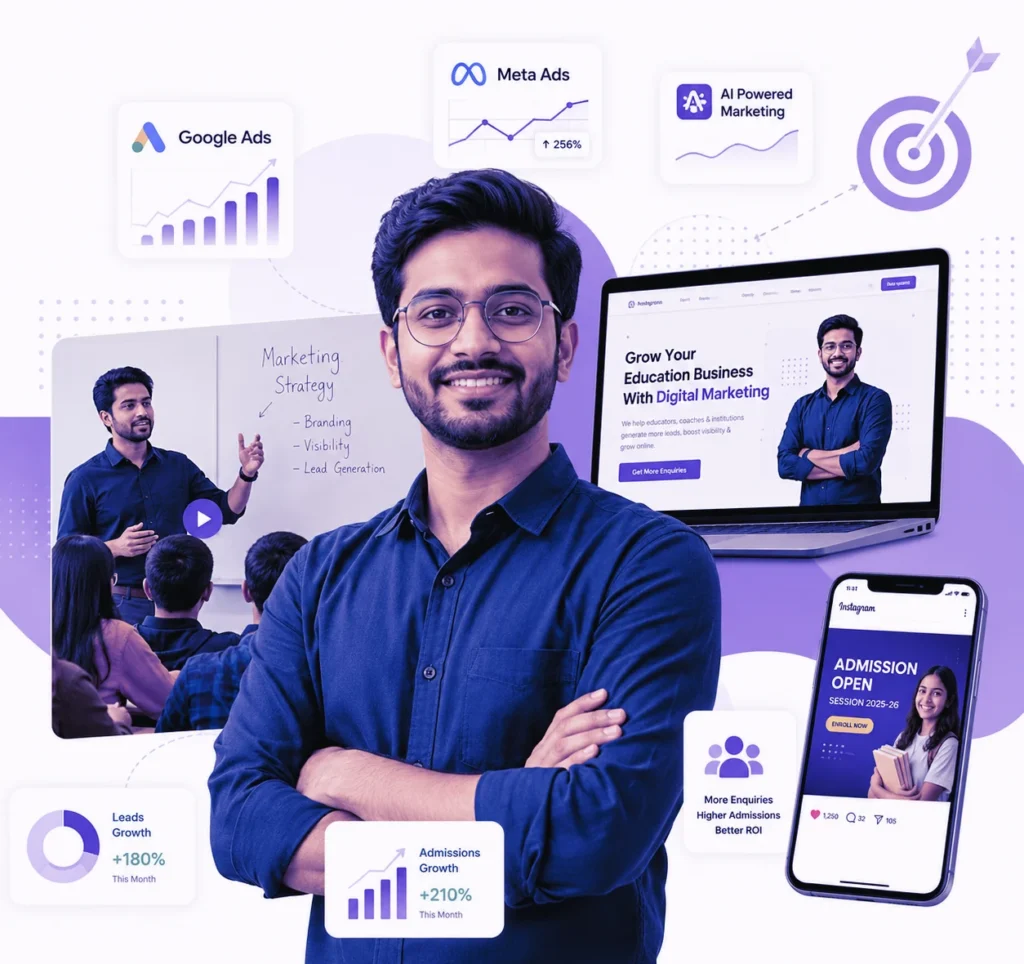
Parents no longer walk into a school to “see what it’s like.” They Google it first, check your reviews, scroll your Instagram, and compare you with three other institutes, all before they ever call you. If your enquiry numbers are flat or your ad spend isn’t turning into admissions, the problem is usually not your teaching. It is that the right families can’t find you online.
That is why digital marketing for educational institutes is now a core part of admissions, not an optional extra. In this guide, we explain what it is, how it works, the real benefits, a step-by-step plan you can follow, and the mistakes that quietly waste budgets.
Key Takeaways
- Digital marketing for educational institutes puts you in front of parents and students at the exact moment they search for options, which traditional marketing cannot do.
- It is usually cheaper per enquiry than hoardings, newspaper ads, or pamphlets, and every rupee can be tracked.
- The biggest results come from connecting channels (Meta Ads, Google Ads, SEO, social media) with follow-up automation, not from running ads alone.
- Most institutes lose admissions not because of low enquiries but because of slow follow-up.
- You can start small: a clear offer, one ad channel, one landing page, and a follow-up system.
What Is Digital Marketing for Educational Institutes?
Digital marketing for educational institutes means using online channels to attract, convince, and enrol students. These channels include:
- Search engines: Google Ads and SEO, so you appear when someone searches “best school near me” or “NEET coaching in [city]”.
- Social media: Meta Ads (Facebook and Instagram), YouTube, and organic content that shows your campus, results, and teaching style.
- Your website: the place where interest becomes an enquiry.
- Messaging and email: WhatsApp, SMS, and email follow-ups that move a lead toward admission.
It applies to schools, colleges, coaching institutes, online academies, tutors, and consultants. The tools differ slightly, but the goal is the same: more qualified student leads and more admissions.
Why Is Digital Marketing Important for Educational Institutes?
Because that is where your audience already is. Parents, students, and teachers use the internet as their first source when looking for quality education. Search engines and social media have replaced word of mouth as the starting point, even though word of mouth still closes the deal.
Three shifts make this especially important now:
- Research starts online. Families shortlist institutes from Google results and Instagram before contacting anyone. If you are not visible, you are not on the list.
- Competition is louder. New private schools, online academies, and freelance educators are all marketing themselves. A small tutoring centre can now compete for attention with a large college.
- Admissions are seasonal. Peak admission windows are short. Digital campaigns can be switched on, adjusted, and paused quickly, so you can concentrate spend when it matters.
In short, if your competitors are visible online and you are not, they get the first conversation.
How Does Digital Marketing Work for Schools and Institutes?
Think of it as a flow with four stages. At DigigoFly, we build this as The Student Flow System, a connected setup instead of scattered campaigns.
Stage 1: Attract. Targeted ads and search visibility put your institute in front of the right families. For example, a coaching institute can show ads only to parents of Class 10 students within 10 km.
Stage 2: Capture. A focused landing page or lead form collects the enquiry. It should have one clear offer, such as a free demo class, campus visit, or scholarship test.
Stage 3: Nurture. Automated WhatsApp and email messages reply within minutes, share fee details, and remind the family about demo classes. This is where many institutes lose leads, because manual follow-up is slow.
Stage 4: Convert and measure. Your counsellors speak to warm leads, and dashboards show which campaigns actually produced admissions, not just clicks.
When all four stages work together, ad spend becomes predictable and repeatable.
Key Benefits of Digital Marketing for Educational Institutes
1. Stronger brand awareness
Digital marketing is one of the fastest ways to raise visibility. Parents and students can learn about your institute, see your faculty, and read reviews without visiting first. It also helps newer players, such as private tutoring centres or freelance teachers, compete with larger institutions.
2. Lower cost than traditional marketing
Channels like SEO, social media, and email marketing can be very low cost, and sometimes the starting budget is close to zero. Even paid advertising on digital platforms is often cheaper than print or outdoor ads, so you can reach a larger audience for less.
3. Personalised messaging
Traditional ads send one message to everyone. With data-driven campaigns you can speak differently to parents of a Class 6 student, a Class 12 board-exam student, and a working professional looking for an online course.
4. Higher conversion rates
Reaching people across several channels (social, search, email, and paid ads) increases traffic and gives you more chances to convert. You can keep improving your campaigns over time to lift conversions further.
5. Real-time tracking
Every campaign can be measured. Analytics tools show where leads come from, what each enquiry costs, and which ads are not working. You can cut losses quickly and move budget to what performs, which is especially useful during off-season months.
6. Trust and credibility
A well-run website, strong Google reviews, and consistent social content signal that your institute is established and reliable. Trust is often the deciding factor between two similar institutes.
Step-by-Step Guide to Getting Started
You do not need a huge budget to begin. Follow these steps in order.
Step 1: Define your audience and your offer
Decide exactly who you want: parents of Class 8 students, NEET aspirants, or adult learners. Then create one clear, low-risk offer, such as a free demo class, a scholarship test, or a campus tour. Vague messages like “admissions open” rarely convert.
Step 2: Fix your digital foundation
Before spending on ads, make sure these are ready:
- A mobile-friendly website that loads fast and shows fees, courses, results, and contact details clearly
- A claimed and complete Google Business Profile with photos and recent reviews
- A dedicated landing page for each campaign
- Basic tracking (Google Analytics, Meta Pixel, and conversion tracking)
If your website needs work, our team can help with AI SEO and GEO for education brands, so your institute also shows up in AI-generated answers, not just traditional search.
Step 3: Launch one or two paid channels
Start with the channels closest to your audience:
- Google Ads captures high-intent searches. Parents typing “best school in [city]” are ready to act. See how this works in our guide to Google Ads for schools.
- Meta Ads build demand by reaching families who are not searching yet but fit your profile. Learn more about Meta Ads for coaching institutes.
A small starting test can be ₹500 to ₹1,000 per day for 2 to 4 weeks, which is usually enough to learn what works.
Step 4: Build consistent organic content
Post short, useful content: faculty introductions, student results (with permission), exam tips, campus life, and parent testimonials. Short videos on Instagram and YouTube tend to build trust faster than static posts. Aim for steady posting, not perfection.
Step 5: Automate follow-up
Speed matters. Set up instant WhatsApp and email replies, reminders for demo classes, and a simple pipeline for your counsellors. This is the heart of marketing automation for admissions, and it is where most institutes see the biggest jump in conversions.
Step 6: Measure and improve every month
Track four numbers: cost per enquiry, enquiry-to-visit rate, visit-to-admission rate, and cost per admission. Review them monthly, pause weak campaigns, and put more budget behind winners.
How Much Does Education Marketing Cost?
Costs vary by city, course, and competition. The table below shows a typical way to think about budgets. Replace the ranges with your own data.
|
Channel |
Typical Starting Point |
What It Does |
Time to Results |
|
SEO and content |
Monthly retainer or in-house effort |
Builds free, long-term traffic |
3 to 6 months |
|
Google Ads |
₹500 to ₹1,000 per day |
Captures high-intent searches |
Days to weeks |
|
Meta Ads |
₹500 to ₹1,000 per day (test) |
Generates enquiries from targeted audiences |
Days to weeks |
|
Social media content |
Low cost to moderate |
Builds trust and brand recall |
2 to 4 months |
|
Automation tools |
Monthly software cost |
Speeds up follow-up and conversions |
Immediate |
Worked example: A coaching institute spends ₹800 per day on Meta Ads for 30 days (₹24,000). If it gets enquiries, the cost per enquiry is ₹24,000 divided by that number. If 1 in 5 enquiries books a demo and 1 in 4 demo attendees enrols, you can calculate the cost per admission and compare it with the fee value of a student. That is the number that tells you whether a campaign is profitable.
Digital Marketing vs Traditional Marketing for Education
Traditional marketing, such as hoardings, pamphlets, and newspaper ads, still has value for local awareness. But the two approaches differ sharply:
|
Factor |
Digital Marketing |
Traditional Marketing |
|
Cost |
Flexible, can start small |
Usually higher fixed cost |
|
Targeting |
By location, age, interest, intent |
Broad, hard to control |
|
Tracking |
Real-time, per campaign |
Mostly guesswork |
|
Personalisation |
High |
Low |
|
Ability to adjust |
Instant |
Slow or impossible |
The smartest institutes use both, but let digital data decide where to invest more.
FAQs
1. Why is digital marketing important for schools and colleges?
Because most parents and students begin their search online. Digital marketing makes sure your institute appears in those searches, builds trust through reviews and content, and lets you measure which efforts bring real admissions.
2. How much should an educational institute spend on digital marketing?
There is no fixed figure. Many institutes start with a test budget for Meta Ads or Google Ads and scale based on cost per admission. A good rule is to set the budget as a share of the revenue one admission brings in, then scale what works.
3. Which is better for admissions: Meta Ads or Google Ads?
Both work, in different ways. Google Ads captures people already searching for an institute or course. Meta Ads reaches relevant families before they start searching. Most institutes get the best results using both together.
4. How long does digital marketing take to show results?
Paid ads can bring enquiries within days. SEO and organic social media usually take three to six months to build steady momentum. Automation improves conversions almost immediately.
5. Can small tutoring centres or independent educators benefit?
Yes. Online marketing lets a small centre or freelance teacher reach local families at low cost and compete with much larger institutions, as long as the offer and follow-up are clear.
6. What is the Student Flow System?
It is DigigoFly’s connected approach to admissions marketing. It combines Meta Ads, Google Ads, SEO, social media, and automation so enquiries are captured, followed up quickly, and tracked through to admission.
7. How do I know if my digital marketing is working?
Track cost per enquiry, enquiry-to-visit rate, and cost per admission. If enquiries are rising but admissions are not, the issue is usually follow-up or lead quality, not traffic.
8. Do I need a new website to start?
Not always. You need a fast, mobile-friendly site with clear course details, fees, and contact options. If your current site does this, you can start with landing pages and improve the site over time.
Conclusion
Digital marketing matters for educational institutes because admissions decisions now begin online, budgets are tighter, and you can finally see what each rupee delivers. The institutes that win are not the ones with the loudest ads. They are the ones with a clear offer, a few well-run channels, and fast follow-up.
If you take three things from this guide: be visible where families search, respond to every enquiry within minutes, and judge success by admissions, not clicks.
Ready to turn online attention into admissions? Book a free consultation call with DigigoFly and we will map out a Student Flow System tailored to your institute.