
You have set aside a budget for admissions. Now someone tells you to “go all-in on Google.” Another says “parents are on Instagram, so Meta is the only way.” Both sound reasonable, and both can waste money if you pick blindly.
The real question behind Google Ads vs Meta Ads for school admissions is not which platform is better. It is which platform fits the stage your parents and students are in, and what your institution needs right now: more enquiries, better-quality enquiries, or more visits and enrolments.
In this guide, we break down how each platform works, what it costs, where it fits in the admission journey, and how to split your budget without guesswork.
Key Takeaways
- Google Ads catches people who are already searching for a school or course. Meta Ads (Facebook and Instagram) puts your institution in front of people who haven’t started searching yet.
- The cheaper platform is not automatically the better one. Judge Google Ads vs Meta Ads for school admissions by cost per enrolment, not cost per lead.
- Google usually suits courses and “near me” searches. Meta usually suits awareness, campus stories, and retargeting.
- Most institutions get better results running both together, with a clear role for each platform.
- Slow follow-up kills good leads on either platform. Response time matters as much as ad quality.
What Is the Google Ads vs Meta Ads Decision?
Both platforms let you pay to reach prospective students and parents. The difference is in how they reach them.
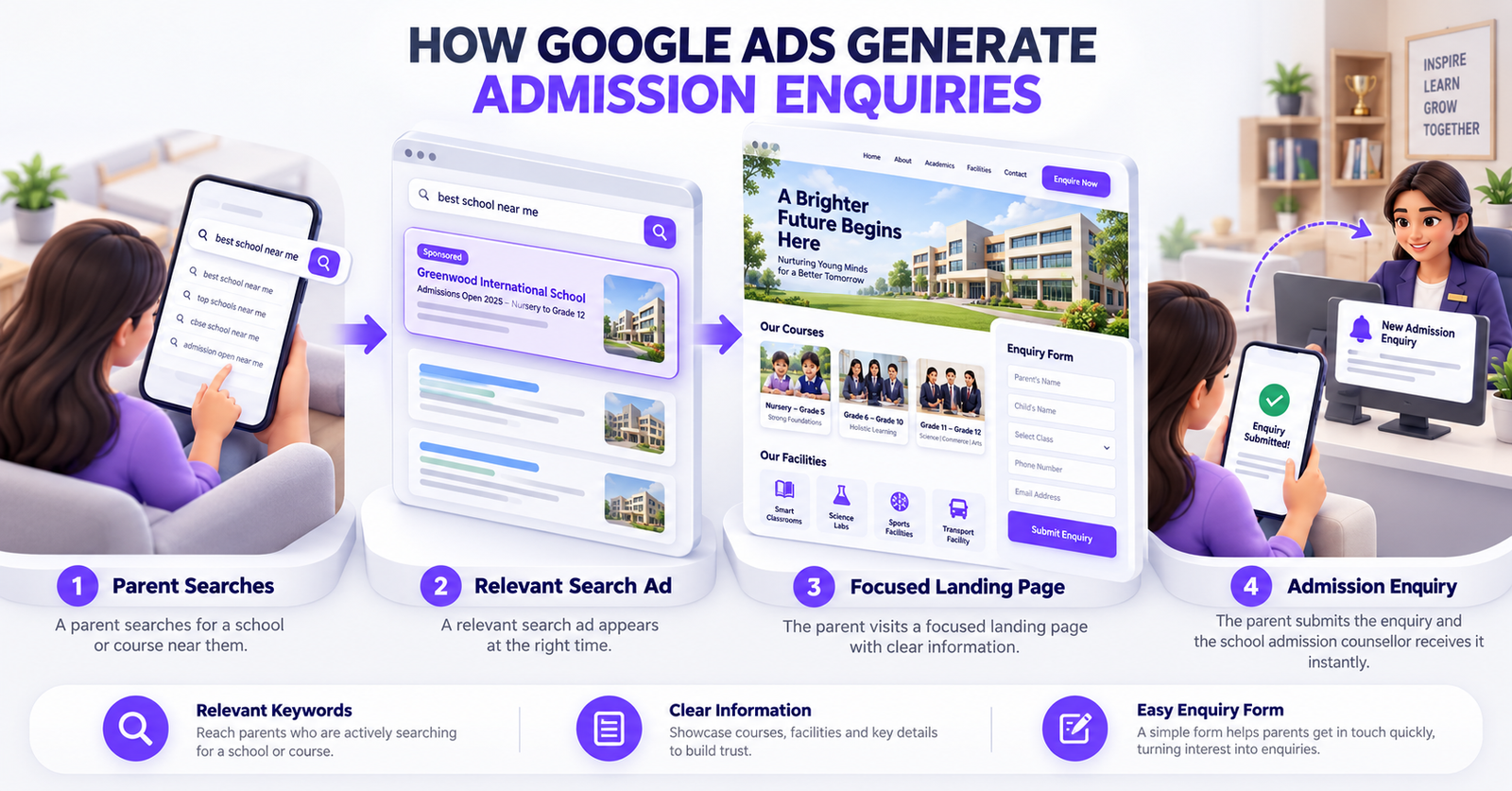
Google Ads shows your ad when someone types a query such as “best CBSE school near me” or “BBA colleges in Kolkata.” The person is already looking. Your job is to be the answer they find.
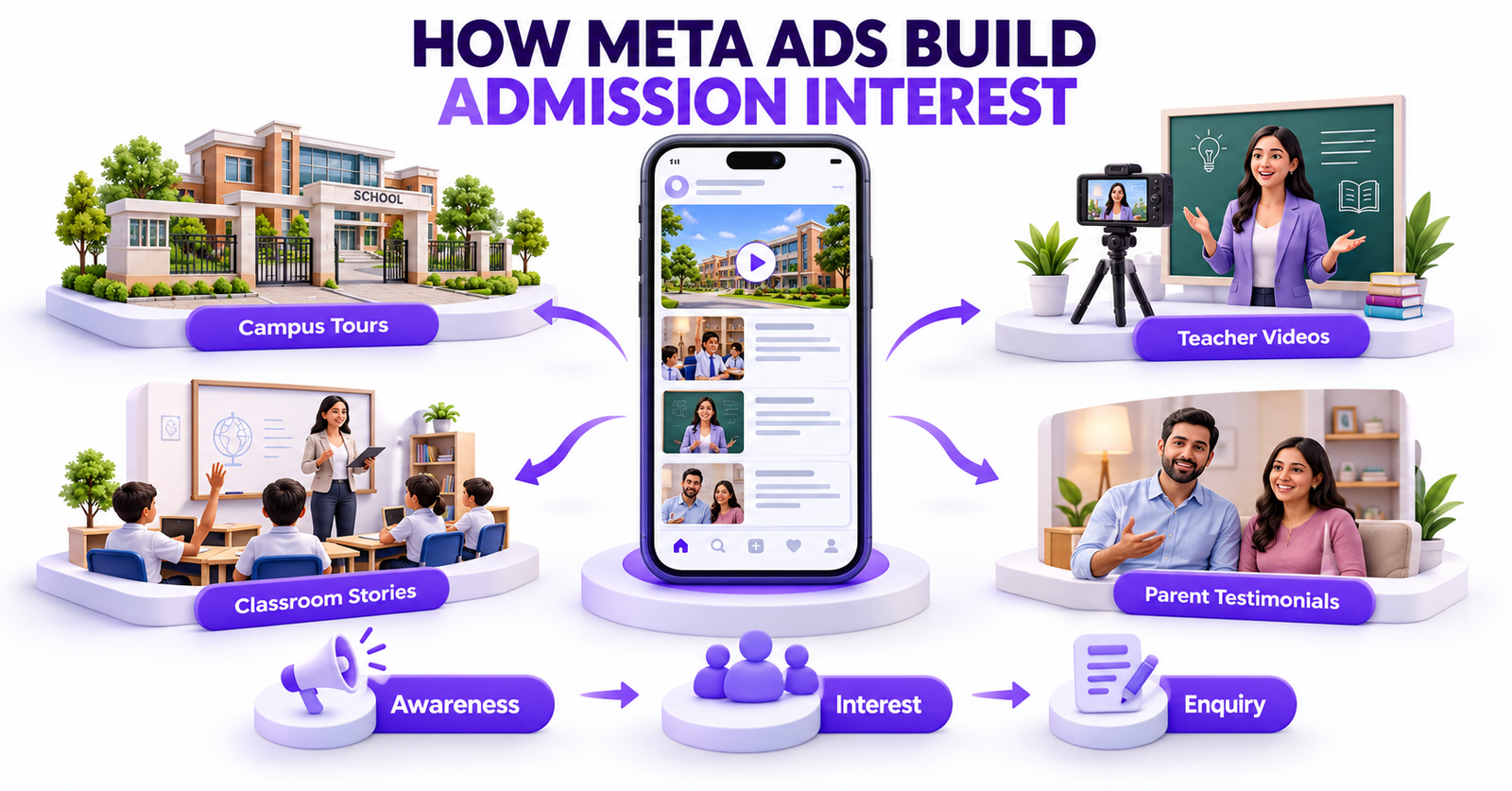
Meta Ads shows your ad inside Facebook and Instagram feeds, Stories, and Reels. The person is scrolling for other reasons. Your job is to interrupt politely, spark interest, and give them a reason to enquire.
Think of it this way. Google is a shop on the main road where people walk in with a shopping list. Meta is a stall at a busy fair where you need to catch attention first.
This is the core of any serious school admission marketing plan. You are matching the platform to the mindset of the person on it.
Why This Choice Matters for Schools and Colleges
Admissions are a high-value, high-consideration decision. A family may spend weeks or months comparing options, and several people usually influence the decision: parents, the student, sometimes grandparents or a counsellor.
That creates three problems for institution owners:
- Seasonal pressure. Most admission demand clusters in a few months. Ad spend during peak season is competitive, so mistakes are costly.
- Long decision cycles. A parent who sees your Instagram ad in November may not enquire until February. If you only measure last-click leads, you will undervalue the platform that started the journey.
- Mixed lead quality. Low-cost enquiries that never pick up the phone hurt your counselling team’s time and morale.
Choosing the right platform mix protects you from all three. It also stops the common argument inside leadership teams about which platform is “working,” because each one has a different job.
How Google Ads Work for Admissions
Google Ads for admissions mainly run on Search campaigns, where your ads appear above or below organic results for relevant queries. You can also use Performance Max, YouTube, and Display, but Search is where most institutions should start.
What Google Ads do well
- Capture high-intent demand. People searching “MBA admission 2027 Pune” are comparing options now.
- Win local searches. “Near me” and area-based keywords are valuable for day schools, preschools, and coaching centres.
- Promote specific courses. A college offering B.Sc. Nursing or Data Science can target exactly those searches.
- Give you control over what you pay for. You choose keywords, locations, and timings, and can block irrelevant searches with negative keywords.
Where Google Ads struggle
- Limited volume for niche or new institutions. If few people search for your school or city, there is only so much traffic to buy.
- Higher cost per click. Competitive education keywords, especially for popular courses, can be expensive.
- No help creating demand. Google can only serve people who already know what they want.
For Google Ads for colleges, this means strong results on course and program searches, and weaker results if the family has not yet heard of your institution.
If you want a closer look at setup, our guide on Google Ads for schools walks through campaign structure, keywords, and landing pages.
What decides whether a search click becomes an enquiry
A strong Google campaign depends on more than keywords. Three things matter:
- Ad relevance. The ad should mention the class, course, or location the person searched for.
- Landing page. One focused page with fee range, facilities, results, and a clear enquiry form beats sending people to your homepage.
- Speed and clarity on mobile. Most parents will see your page on a phone. If it loads slowly or hides the form, you lose them.
How Meta Ads Work for Admissions
Meta Ads run across Facebook and Instagram. You can target by location, age, interests, and behaviours, and you can build audiences from your own data, such as website visitors, video viewers, or enquiry lists.
What Meta Ads do well
- Reach at scale, at a lower cost per click. Meta usually delivers more impressions and enquiries for the same spend.
- Show your campus, culture, and people. Video of classrooms, events, and teachers helps parents feel trust before they ever visit.
- Retarget interested people. Someone who watched half your campus tour video or visited your admissions page can see a follow-up ad.
- Lead forms inside the app. Instant Forms reduce friction because the parent does not leave Instagram or Facebook.
Where Meta Ads struggle
- Lower intent. Many people who fill a form on Meta were curious, not ready. Without quick follow-up, they go cold.
- Creative fatigue. The same ad shown repeatedly stops working. You need a steady flow of fresh videos, reels, and parent testimonials.
- Form-fill quality varies. Easy forms attract more leads and more low-quality ones. You may need to add a qualifying question or two.
For Meta Ads for schools, the best results usually come when ads tell a real story: a principal’s message, a day in the life of a student, a parent explaining why they chose the school. To see how this applies to institutes, read our page on Meta Ads for coaching institutes.
Google Ads vs Meta Ads: Side-by-Side Comparison
Factor | Google Ads | Meta Ads (Facebook + Instagram) |
User mindset | Actively searching | Scrolling, not searching |
Main goal | Capture existing demand | Create and nurture demand |
Typical lead quality | Often higher intent | Varies, needs faster follow-up |
Typical cost per lead | Often higher | Often lower |
Best formats | Search ads, call ads, YouTube | Reels, Stories, video, lead forms |
Best for | Courses, local “near me” searches | Awareness, campus culture, retargeting |
Biggest risk | Paying for clicks that don’t convert | Paying for leads that don’t pick up |
Note: “Often” is deliberate. Results depend on your city, class level, season, and creative quality. Always compare using your own data.
Benefits of Using Both Platforms Together
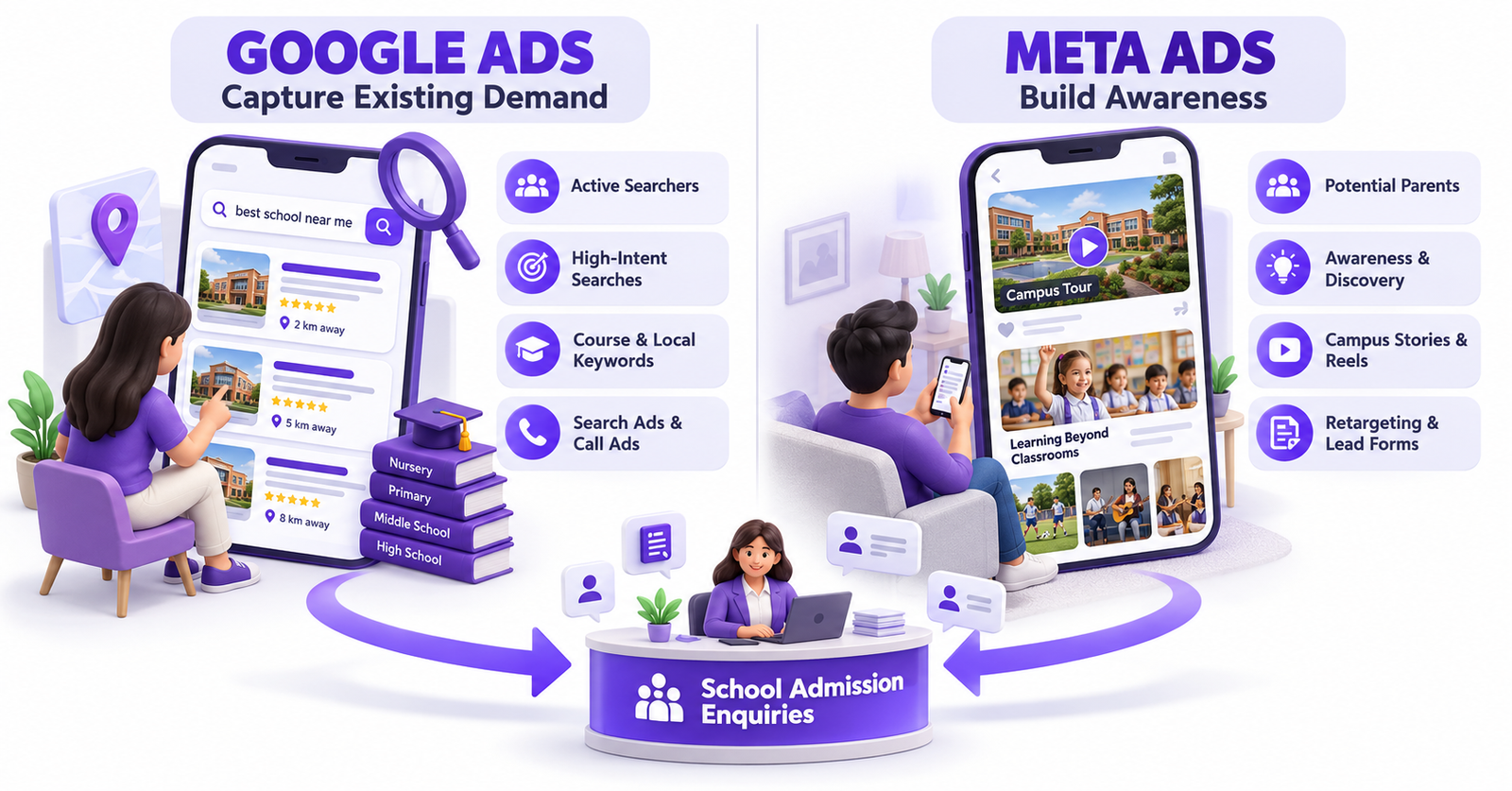
The strongest school admission marketing plans rarely depend on a single platform. Here is why combining them works:
- They cover the full journey. Meta introduces your school to families who haven’t started searching. Google catches them when they do.
- They support each other. A parent who sees your Instagram video may later search your school’s name on Google. A branded search like that is cheap and converts well.
- Retargeting closes gaps. Visitors from Google can be retargeted on Meta, and Meta viewers can see Google ads when they search later.
- You reduce risk. If one platform has a bad month, the other keeps enquiries coming.
- You learn faster. Comparing lead quality across both platforms shows you which messages and audiences actually lead to admissions.
The typical parent journey looks like this:
- Awareness: sees a reel or post about your school.
- Research: searches for schools or courses on Google.
- Comparison: visits your site, reads reviews, checks fees and facilities.
- Decision: enquires, visits the campus, and applies.
Meta is strongest at stage 1, Google at stages 2 and 3, and both help at stage 4 through retargeting and quick follow-up.
Step-by-Step Guide to Building Your Admissions Ad Plan
Step 1 — Define Your Real Goal and Number
Start with enrolments, not enquiries. Work backwards:
- How many new admissions do you need this season?
- What percentage of enquiries become campus visits?
- What percentage of visits become admissions?
If you need 100 admissions and 1 in 10 enquiries converts, you need about 1,000 qualified enquiries. That number sets your budget and shows whether your goal is realistic.
Step 2 — Map Your Audience and Their Search Behaviour
List who you are targeting: parents of Class 1 applicants, parents of Class 9 transfers, Class 12 students looking at colleges, and so on. For each group, note what they would type into Google and what would catch their attention on Instagram.
Use this to build two lists: keywords for Google and themes for Meta.
Step 3 — Launch Google Search Campaigns for High-Intent Demand
Set up separate campaigns for different intents:
- Branded searches (your school or college name)
- Local searches (“best school in [area]”)
- Course or class searches (“B.Com admission,” “Class 11 science”)
Add negative keywords like “jobs,” “free,” or “result” to avoid wasted clicks. Send each campaign to a matching landing page.
Step 4 — Launch Meta Campaigns for Awareness and Lead Generation
Run at least two types of campaigns:
- Awareness/engagement: video tours, student stories, and event highlights to reach new families.
- Lead generation: a clear offer such as a campus visit, counselling session, or admission guide, with a short form.
Test different creatives. Parent testimonials and short campus videos often outperform polished brand ads, but test it for your audience instead of assuming.
Step 5 — Set Up Retargeting
Build audiences from website visitors, video viewers, and people who opened a lead form but did not submit. Show them a more direct message: “Admissions closing soon” or “Book your campus visit.”
Step 6 — Respond Fast and Track Everything
This step decides whether your ad spend pays off. Aim to contact every lead within minutes, not days. An automated first message by WhatsApp or SMS, followed by a counsellor call, can lift contact rates significantly. This is the idea behind our marketing automation for education approach.
Track cost per lead, cost per visit, and cost per admission for each platform. That is how you decide where to put the next rupee.
Budget and Cost: What to Expect
Budgets vary widely by city, class level, and competition, so be wary of anyone who quotes a fixed number without asking about your institution. Here is a practical way to think about it:
- Ad spend is what you pay Google and Meta.
- Creative cost covers video, photos, and design. Meta needs more of this.
- Landing page and tracking are one-time setup costs that pay off on both platforms.
- Follow-up cost is your counselling team’s time, plus any CRM or automation tool.
Cost per lead alone can mislead. A comparison like this is more honest:
Metric | Platform A (example) | Platform B (example) |
Cost per lead | Lower | Higher |
Lead-to-visit rate | Lower | Higher |
Cost per visit | Compare | Compare |
Cost per admission | The number that matters | The number that matters |
A suggested starting split is in the table near the end of this article. Treat it as a hypothesis and adjust after 4 to 6 weeks of data.
A Worked Example
This is an illustrative scenario, not a client result.
Imagine a mid-sized private school in a tier-2 city that wants 80 new admissions for Classes 1 to 8. It has ₹[INSERT BUDGET] a month for ads.
Plan:
- Google Search (about 40%). Campaigns for “best school in [area],” “CBSE school admission,” and branded searches. Landing page with fee range, facilities, and a visit-booking form.
- Meta Awareness and Leads (about 45%). Reels of classroom activities, a principal’s welcome video, and a lead form offering a campus visit.
- Retargeting (about 15%). Ads for website visitors and video viewers on both platforms.
What to watch for:
- If Google leads convert to visits at a higher rate, shift more budget there, until you hit the limit of available search demand.
- If Meta leads are plentiful but few answer calls, improve the form questions and follow-up speed before cutting spend.
- If branded searches rise after Meta campaigns start, that is a sign the two platforms are working together.
This kind of setup is what we build as part of The Student Flow System at DigigoFly, where ads, landing pages, and follow-up are designed as one connected flow instead of separate pieces.
Which Platform Should You Prioritise?
Use this table as a starting point, then adjust using your own cost per admission data.
Institution type | Suggested starting emphasis | Why |
New or lesser-known school/college | More Meta, supported by Google | Few people search for you yet, so build awareness first |
Established institution with strong reputation | Balanced Meta and Google | Existing search demand plus ongoing brand building |
Institution with specific courses and high search demand | More Google, supported by Meta retargeting | Families actively search for the program |
Preschool or local day school | Local Google plus local Meta | Both rely on proximity and trust |
These are starting hypotheses, not rules. Two schools in the same city can need different mixes depending on brand awareness, fee level, and competition.
FAQs
Which is better for school admissions, Google Ads or Meta Ads?
Neither is better in every case. Google Ads tends to bring higher-intent leads from people already searching, while Meta Ads brings volume and awareness at a lower cost per lead. Most institutions do best using both, with a clear role for each.
Are Meta Ads leads lower quality than Google Ads leads?
Often they need more nurturing, because people on Meta weren’t actively searching. That doesn’t make them bad leads. With a good qualifying question and fast follow-up, Meta can produce strong admissions at a lower cost.
How much should a school spend on Google Ads and Meta Ads?
It depends on your city, class level, and admission target. Work backwards from the number of admissions you need and your lead-to-admission rate, then set a budget that supports that number of enquiries. A DigigoFly consultant can help you estimate this for your institution.
Is Google Ads good for college admissions?
Yes, especially for specific courses and programs, since students and parents search by course name and city. It works best with a focused landing page for each program.
Do Instagram ads work for schools?
Yes, when the content shows real campus life and builds trust. Short videos, parent testimonials, and event highlights usually work better than generic promotional posters.
How long does it take to see results from admission ads?
Google Ads can bring enquiries within days of launch. Meta Ads also generate leads quickly, but both need two to six weeks of data before you can optimise confidently. Admissions themselves take longer, depending on your counselling and visit cycle.
What is a good cost per lead for school admissions?
There is no single number. Cost per lead varies by location, class, season, and platform. A better measure is cost per admission, which shows what you actually pay to enrol a student.
Should I run both platforms from day one?
In most cases, yes, if your budget allows. Start with a smaller budget on each so you can compare, then move spend towards the platform with the better cost per admission.
Conclusion
The debate around Google Ads vs Meta Ads for school admissions goes away once you see each platform as part of one journey. Meta helps families discover you and build trust. Google captures them at the moment they are ready to compare and decide.
Three things matter most. Measure cost per admission, not just cost per lead. Match each platform to a specific stage of the journey. And respond to every enquiry fast, because even the best ad is wasted if the lead goes cold.
If you’d like a clear plan for your institution, book a free consultation call with DigigoFly. We will look at your admission goals, your current ads, and how to build your own Student Flow System that connects ads, follow-up, and enrolments.